Key Takeaways
- Charlotte's Piedmont red clay soil expands and contracts with moisture, causing foundation settling, cracks, and drainage issues across the metro
- Foundation repair costs $5,000-$15,000+ in Charlotte depending on severity — crawl space encapsulation adds $5,000-$8,000
- Traditional buyers require foundation repairs before closing — cash investors buy as-is
- Multiple offers from a marketplace get you 8-15% more than a single cash buyer for houses with foundation damage
- Disclosure is required: NC Residential Property Disclosure Act (NCGS 47E) mandates sellers disclose known foundation issues
If you own a home in Charlotte, there is a good chance your foundation has been affected by the region's notorious red clay soil. The Charlotte metro sits on Piedmont clay that swells when it absorbs moisture and shrinks when it dries out. Every wet season and every dry spell pushes, pulls, and stresses the foundations built on top of it.
Foundation damage is one of the most common structural problems in the Charlotte area. It affects homes in every price range and every neighborhood, from 1950s ranch homes in Plaza Midwood to 1980s split-levels in south Charlotte. And it creates a real problem when you need to sell.
This guide covers everything Charlotte homeowners need to know about selling a house with foundation problems: what causes the damage, what repairs cost, whether to fix or sell as-is, what you must disclose under North Carolina law, and how to get a fair price from competing cash investors instead of accepting a lowball offer from a single buyer.
Why Charlotte Has Widespread Foundation Problems
Charlotte and the surrounding Mecklenburg County sit on the Piedmont Plateau, a geological region defined by its dense red clay soil. This clay is the single biggest factor behind foundation problems across the Charlotte metro, and it affects nearly every home built in the area.
The Red Clay Problem
Piedmont red clay is highly reactive to moisture changes. When Charlotte's spring and summer rains saturate the ground, the clay expands significantly, pushing upward against foundations with tremendous force. During dry periods, the clay contracts and pulls away from foundation walls, creating voids and removing the support the foundation relies on.
This constant expansion-contraction cycle is what makes Charlotte foundations move. It's not a one-time event — it's an ongoing process that compounds over years and decades, gradually shifting, cracking, and settling the foundations built on top of it.
The Climate Factor
North Carolina's humid subtropical climate makes Charlotte's foundation problems worse than they might otherwise be. The region receives roughly 43 inches of rain per year, but that rainfall is unevenly distributed. Heavy downpours followed by dry stretches create the exact wet-dry cycles that Piedmont clay responds to most aggressively. And the year-round humidity means moisture is constantly working its way into crawl spaces and against basement walls, compounding structural damage from below.
The Aging Housing Stock
Many Charlotte homes were built between the 1950s and 1980s during the city's major growth periods. These homes are now 40 to 70+ years old, and their foundations have endured decades of Piedmont clay movement. The cumulative effect of thousands of expansion-contraction cycles takes a visible toll — cracks widen, floors slope, and structural integrity gradually degrades.
Types of Foundation Damage in Charlotte Homes
Charlotte homes sit on several foundation types, and each one fails differently on the region's red clay soil.
Crawl Space Foundations
A large number of Charlotte homes — especially those built before the 1980s — sit on crawl space foundations. These homes are elevated above the ground on a system of block or poured concrete walls and interior piers, with a crawl space underneath.
Common crawl space problems include:
- Moisture and mold: Charlotte's humidity drives moisture into crawl spaces, rotting wood supports and fostering mold growth
- Settling piers: Red clay movement causes interior piers to sink or shift, creating uneven floors above
- Bowing walls: Hydrostatic pressure from saturated clay pushes inward against crawl space perimeter walls, causing them to bow or crack
- Pest damage: Moist crawl spaces attract termites and other wood-destroying insects that further weaken structural supports
Basement Foundations
Many Charlotte homes, particularly those built on sloped lots in neighborhoods like Dilworth, Myers Park, and parts of east Charlotte, have full or partial basements. These are especially vulnerable to the combination of red clay soil and Charlotte's rainfall.
Common basement problems include:
- Bowing basement walls: Expansive clay soil pushes inward against basement walls, causing visible bowing, cracking, and in severe cases, structural failure
- Water intrusion: Hydrostatic pressure forces water through cracks and joints, leading to flooding and ongoing moisture damage
- Floor cracking: Differential settlement cracks the basement floor slab as the clay underneath shifts unevenly
- Stair-step cracking: Block basement walls develop characteristic stair-step cracks along mortar joints as the wall moves
Slab-on-Grade Foundations
Newer Charlotte homes and some commercial-to-residential conversions sit on concrete slab foundations. While less common than crawl spaces in older Charlotte neighborhoods, slabs are increasingly prevalent in newer construction.
Common slab problems include:
- Settlement: Clay contraction creates voids beneath the slab, causing sections to sink
- Upheaval: Clay expansion pushes sections of the slab upward, creating uneven floors
- Cracking: Differential movement cracks the slab itself
Warning Signs to Watch For
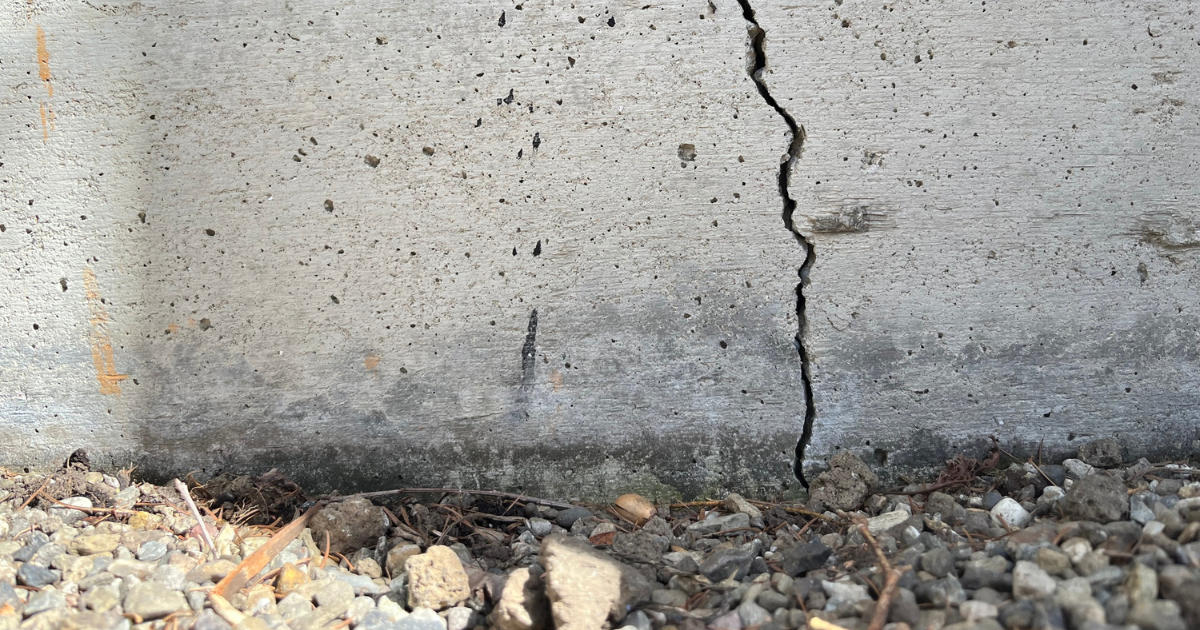
Regardless of your Charlotte home's foundation type, these are the red flags that indicate foundation movement:
- Diagonal cracks radiating from window and door corners
- Doors and windows that stick or won't close properly
- Uneven or sloping floors
- Gaps between walls and ceiling or walls and floor
- Cracks in exterior brick or mortar (stair-step patterns are especially telling)
- Standing water or persistent moisture in the crawl space or basement
- Musty odors rising from below the first floor
Foundation Repair Costs in Charlotte
Foundation repair costs in Charlotte vary based on foundation type, severity of damage, and the repair method required.
Foundation Stabilization and Repair
| Repair Type | Cost Range |
|---|---|
| Pier installation / underpinning (moderate) | $5,000 - $10,000 |
| Extensive foundation repair (severe settling/cracking) | $10,000 - $15,000+ |
Crawl Space and Moisture Repair
| Repair Type | Cost Range |
|---|---|
| Crawl space encapsulation | $5,000 - $8,000 |
| Basement wall stabilization (carbon fiber / wall anchors) | $5,000 - $12,000 |
| Interior drainage and sump pump system | $3,000 - $8,000 |
Additional Costs
- Structural engineering report: $300 - $500 (required by most repair companies and often required by buyers)
- Post-repair cosmetic and landscaping fixes: $2,000 - $5,000 (foundation work disrupts landscaping, cracks drywall during leveling, and may require repainting)
- Mecklenburg County building permits: Required for major foundation work — your contractor handles the application, but permit fees add to the total cost
Foundation repair rarely ends at the foundation. Leveling a settled foundation often cracks drywall, separates tile, displaces cabinets, and breaks plumbing connections. In Charlotte, you also frequently need crawl space encapsulation on top of structural repairs to address the underlying moisture problem. Budget 10-20% above the foundation quote for cosmetic and collateral repairs.
Repair vs. Sell As-Is: The Math
This is the decision every Charlotte homeowner with foundation problems faces. Let's run the actual numbers.
Example: $420,000 Charlotte Home with $12,000 Foundation Repair
Option 1: Repair and Sell Traditionally
| Expected sale price (after repair) | $420,000 |
| Foundation repair | -$12,000 |
| Crawl space encapsulation | -$6,000 |
| Agent commission (6%) | -$25,200 |
| Closing costs | -$4,000 |
| Carrying costs (4 months at $2,400/mo) | -$9,600 |
| Net proceeds | $363,200 |
| Timeline | 4+ months |
Option 2: Sell As-Is With Multiple Cash Offers
| Multiple offers range | $315,000 - $357,000 |
| Repairs | $0 |
| Commissions / fees | $0 |
| Carrying costs | $0 |
| Net proceeds | $315,000 - $357,000 |
| Timeline | 14 days |
The Bottom Line
In this example, the as-is marketplace route nets $315,000-$357,000 in 14 days with zero out-of-pocket costs. The traditional repair-and-sell route nets $363,200 after 4+ months, $18,000 in upfront repair costs, and the risk that repairs reveal additional problems or that the buyer negotiates further after inspection.
For many Charlotte homeowners, selling as-is with multiple offers breaks even or comes out ahead — plus you save months of time and eliminate the risk of repair cost overruns.
North Carolina Disclosure Requirements for Foundation Problems
You cannot hide foundation problems when selling in North Carolina. And you shouldn't try.
NC Residential Property Disclosure Act (NCGS 47E)
Under the North Carolina Residential Property Disclosure Act (NCGS 47E), sellers must complete the NC Residential Property and Owners' Association Disclosure Statement, disclosing known material defects in good faith. Foundation issues fall squarely under the structural condition section of this form.
If you know about foundation cracks, settling, crawl space moisture, bowing walls, previous repairs, or engineering reports — you must disclose them. The standard is what you actually know, not what an inspector might find. You're not required to investigate, but you cannot deny knowledge of issues you're clearly aware of.
Consequences of Non-Disclosure
- Rescission and damages: Buyers can sue for undisclosed defects, potentially rescinding the sale entirely
- Fraud claims: Intentionally concealing known foundation defects exposes sellers to fraud liability under North Carolina law
- As-is clause has limits: Selling as-is does not protect sellers who actively conceal or misrepresent known defects — North Carolina courts have consistently upheld this distinction
Why Disclosure Actually Helps with Cash Investors
Here's the counterintuitive part: full disclosure is actually an advantage when selling to cash investors. These buyers expect foundation problems. They price them into their offers upfront. And because they go in with eyes open, they almost never litigate over disclosures after closing.
Compare that to a traditional retail buyer who discovers an undisclosed crack six months after closing and hires a lawyer. Honesty protects you legally and makes the transaction smoother.
Charlotte Neighborhoods Most Affected by Foundation Issues
While the entire Charlotte metro sits on Piedmont red clay, some areas are hit harder than others due to soil composition, housing age, topography, and foundation type.
Plaza Midwood and Oakhurst
Some of the oldest housing stock in Charlotte. Many homes built in the 1940s-1960s on crawl space foundations. Decades of red clay movement combined with aging structural supports make foundation problems extremely common in these established neighborhoods.
Dilworth and Myers Park
Historic homes with a mix of crawl space and basement foundations. The hilly terrain in these neighborhoods adds gravity-driven soil pressure to the existing clay expansion problem. Basement walls in these areas are especially prone to bowing and water intrusion. Some of the most expensive foundation repairs in Charlotte occur in these high-value neighborhoods.
NoDa and Villa Heights
The revitalization of these neighborhoods has put a spotlight on the aging foundations underneath. Many 1950s-era homes that sat neglected for years are now being evaluated for sale, and buyers are discovering decades of deferred foundation maintenance.
South Charlotte (Ballantyne, Pineville)
Newer construction from the 1990s and 2000s sits on some of the heaviest clay in the metro. While these homes haven't had as many decades of soil cycles, the particularly reactive clay in south Mecklenburg County is already causing noticeable settling and cracking in homes just 20-30 years old.
East Charlotte (Independence Blvd Corridor)
The 1960s-1980s homes that make up much of east Charlotte were built during a period of rapid suburban expansion. Many were constructed on minimally prepared red clay soil. After 40-60 years of seasonal movement, these foundations frequently show cracking, settling, and significant crawl space moisture problems.
Even newer construction in areas like Harrisburg, Mint Hill, and Lake Norman is not immune to Piedmont clay movement. The red clay extends across the entire Charlotte metro region. Newer homes simply haven't had as many decades of soil cycles yet — but the process is already underway.
How Cash Investors Price Foundation Damage
Understanding how investors calculate their offers helps you evaluate whether a price is fair or a lowball.
The ARV Formula
Every cash investor uses some version of this formula:
ARV - Repair Costs - Holding Costs - Profit Margin = Offer
ARV (After-Repair Value) is what the home would sell for in perfect condition. For a Charlotte home with an ARV of $420,000 and $12,000 in foundation repairs plus $6,000 for crawl space encapsulation, a typical investor calculation looks like this:
- ARV: $420,000
- Foundation repair: -$12,000
- Crawl space encapsulation: -$6,000
- Cosmetic repairs after foundation work: -$5,000
- Holding costs (3-4 months of carrying the property): -$10,000
- Profit margin (15-25%): -$63,000 to -$105,000
Why Single Buyers Lowball
A single cash buyer has no competition. They know you have limited options with a foundation-damaged home — iBuyers won't touch properties with structural issues, and traditional buyers can't get financing. So the single buyer estimates repairs high, pads their profit margin wide, and presents a take-it-or-leave-it offer. There's no incentive to sharpen their numbers because nobody else is bidding.
Why Multiple Investors Give You More Options
When multiple investors bid on the same foundation-damaged property, the math changes. Each investor knows that if their offer is too low, another buyer will win the deal. So they tighten their repair estimates, accept thinner profit margins, and submit their most competitive number. Competition does what no amount of negotiation with a single buyer can do — it forces fair pricing.
Our national network of investors are ready to make offers on your property — including specialists who do foundation repairs cheaper than retail.
See What Cash Buyers Will OfferWhy a Marketplace Gets You More for a Foundation-Damaged Home
Foundation damage scares most traditional buyers. But it doesn't scare experienced investors — especially those who specialize in structural repairs.
Specialized Buyers Bid More
Among the a national network of investors on a marketplace like Propcash, some specialize specifically in foundation-damaged properties. They have long-standing relationships with foundation repair companies across the Charlotte metro. They buy materials at contractor pricing. They can complete a $12,000 retail foundation repair for $7,000-$8,000. That cost advantage means they can offer you more and still make their numbers work.
Competition Forces Fair Pricing
When 3-5 investors are bidding on your foundation-damaged Charlotte home, each one knows the others are doing the same math. The investor who pads their repair estimate by $10,000 loses the deal to the one who estimates accurately. The one who demands a 25% profit margin loses to the one who'll accept 15%. Competition eliminates the fat from every line item in the formula — and the savings flow to you as a higher offer.
iBuyers Won't — But Cash Investors Will
If you've looked into selling online, you've probably discovered that iBuyers like Opendoor and Offerpad won't purchase homes with foundation problems. Their algorithms and business models are built for move-in-ready homes that need minimal work. Foundation damage is an automatic disqualifier.
Cash investors, on the other hand, regularly buy Charlotte homes with foundation issues. It's a core part of their business. And when a national network of investors is interested in your property, you get fair market pricing even with structural damage.
How the Marketplace Process Works
- Submit your property details — takes about 2 minutes, including notes about foundation condition
- Property broadcast to a national network of investors — including foundation repair specialists
- Receive multiple offers — typically within 24-48 hours
- Compare and choose — or decline all offers with zero obligation
- Close in as few as 14 days — through a licensed North Carolina closing attorney
Frequently Asked Questions
How much does foundation repair cost in Charlotte, NC?
Foundation repair in Charlotte typically costs $5,000-$15,000+ depending on the severity and type of damage. Crawl space encapsulation, which addresses the moisture problems that worsen foundation issues in Charlotte's humid climate, costs an additional $5,000-$8,000. Add $300-$500 for a structural engineering report and $2,000-$5,000 for cosmetic and landscaping repairs afterward.
Do I have to disclose foundation problems when selling in North Carolina?
Yes. The North Carolina Residential Property Disclosure Act (NCGS 47E) requires sellers to disclose known material defects, including foundation problems, on the NC Residential Property and Owners' Association Disclosure Statement. You must disclose what you know in good faith. You are not required to hire an inspector, but you cannot conceal known issues. Non-disclosure can result in lawsuits and rescission of the sale.
Can I sell a house with foundation problems on the MLS in Charlotte?
You can list it, but most traditional buyers will walk away after the inspection or demand full repairs before closing. FHA and conventional lenders typically will not finance homes with significant foundation damage. Charlotte's median home price of $420,000 means foundation problems can drop your value 10-20% on the traditional market, leaving cash buyers as your primary option.
Why are foundation problems so common in Charlotte?
Charlotte sits on Piedmont red clay soil that expands when wet and contracts when dry, causing foundation settling, cracking, and drainage issues. North Carolina's humid subtropical climate makes moisture problems worse year-round, leading to crawl space moisture, mold, and bowing basement walls. Many Charlotte homes built between the 1950s and 1980s have aging foundations that have endured decades of this soil movement.
How do cash investors handle foundation damage in Charlotte?
Cash investors estimate foundation repair costs and subtract them from their offer using the ARV (after-repair value) formula: ARV minus repair costs minus holding costs minus profit margin equals their offer. Investors with foundation repair connections can often complete repairs 20-40% cheaper than retail, which means they can offer you more. With a national network of investors competing on a marketplace, they sharpen their numbers to win deals.
Get Fair Cash Offers for Your Foundation-Damaged Charlotte Home
Foundation problems don't have to mean a financial disaster. Charlotte investors deal with foundation damage every single day — it's one of the most common structural issues in the Piedmont region. The difference between a fair deal and a lowball is whether one buyer dictates the price or multiple buyers are interested in it.
You don't need to spend $15,000+ on repairs and encapsulation. You don't need to wait 4 months for a traditional sale. And you definitely don't need to accept the first low offer from a single "we buy houses" company.
See What Charlotte Investors Will Pay for Your Home — Foundation Problems and All
- Our network of cash investors — including foundation repair specialists
- Sell as-is — no foundation repairs, no crawl space work, no staging
- Close in as few as 14 days — or on your timeline
- No fees or commissions — keep your full offer
- Zero obligation — just see what investors will pay
Disclaimer: This article is for informational purposes only and does not constitute legal, structural engineering, or financial advice. Foundation repair costs and methods vary by property. North Carolina disclosure requirements and real estate laws may change. Consult with a licensed structural engineer for foundation assessments and a North Carolina real estate attorney for legal advice specific to your situation.