
Key Takeaways
- The ground is the usual cause: The Colorado Geological Survey describes Colorado Springs clay soils as typically expansive, with the Pierre Shale and Dawson claystone showing moderate to very high swelling potential.
- Most damage here is heave, not sinking: Swelling clay pushes slabs and foundations up. Settlement from collapsible soil also occurs, mostly east of I-25.
- Disclosure covers the past, too: Colorado's SPD19 form asks about foundation movement and added structural supports that ever existed, plus any soils or engineering reports you hold.
- Financed buyers face extra checkpoints: FHA rules require the lender to confirm the foundation will be serviceable for the life of the mortgage, which often means an engineer's report.
- You have three paths: Repair then list, list as-is to financed buyers, or sell as-is for cash. A small, affordable fix may net more if you repair first.
If you need to sell a house with foundation problems in Colorado Springs, Colorado, you are likely dealing with expansive soil, which the Colorado Geological Survey calls the state's "most significant geologic hazard." The cracks, the sticking doors, and the engineer's letter can leave you feeling stuck. The good news is that you have real options, and none of them require you to pretend the problem is not there.
This guide explains why Colorado Springs foundations move, what Colorado's disclosure form asks, and why lenders can slow a sale. It then compares three ways to sell, so you can pick the one that fits your budget and your timeline.
Why wait? Sell your house “as is” for cash today
Tell us about your house. We'll make you a cash offer based on local market data.
Let's chatWhy Do Colorado Springs Houses Have Foundation Problems?
Many Colorado Springs foundation problems trace back to expansive soil, clay that swells when it gets wet and shrinks when it dries. The Colorado Geological Survey calls expansive or swelling soil Colorado's "most significant geologic hazard" (Colorado Geological Survey, accessed October 2026). Your house did nothing wrong. It sits on ground that moves.
Expansive soil in Colorado Springs
A Colorado Geological Survey seminar paper on local engineering practice is blunt about the city. It says Colorado Springs "is greatly impacted by the costs and constraints associated with construction on expansive soils." It also says the clay soils in the Colorado Springs and Pueblo areas "are typically expansive to some degree" (Colorado Geological Survey, Geologic Hazards and Engineering Practices in Colorado, March 1996).
The same paper names two local culprits. The Pierre Shale and the claystone of the Dawson formation "can usually be expected to have moderate to very high swelling potential." Weathered clays and clays in creek deposits can swell as well.
How much force swelling clay can produce
The Colorado Geological Survey says swelling clays can expand up to 20% by volume when exposed to water. It says they can exert pressures of 20,000 pounds per square foot or more on foundations (Colorado Geological Survey, accessed October 2026). Nationwide, it estimates the damage at a few billion dollars each year.
The west side's tilted bedrock
Parts of western Colorado Springs carry added risk. A Colorado Geological Survey map outlines areas of steeply dipping bedrock on the city's west side. There, buildings "may be subjected to destructive, differential ground heave" where expansive layers sit near the surface (Colorado Geological Survey, MS-32, 1999). The map notes that actual hazards vary a great deal within that area. A mapped zone is a reason to look closer, not proof of damage.
Heave or Settlement: What Is Your House Doing?
Heave means the ground pushes your house up, and settlement means the ground drops out from under it. Both crack concrete and drywall, but they start differently and call for different fixes. Knowing which one you likely have helps you read an engineer's report.
Heave: the common Colorado Springs story
Heave happens when water reaches swelling clay under a slab or footing. The clay expands and lifts the part of the house above it. Colorado Geological Survey guidance says either swelling or shrinking can cause damage, "but swelling accounts for most of the damage in Colorado" (Colorado Geological Survey, Special Publication 14, 1987).
Basement floors and outdoor concrete take the worst of it. They are light, so they have little weight to resist uplift. That is why a basement slab can crack while the main floor above looks fine.
Settlement: collapsible soil east of I-25
Settlement is the opposite movement. Some loose, dry soils lose volume when they get wet, a process engineers call hydrocompaction or collapse. A 1996 Colorado Geological Survey paper says these wind-blown loess deposits "are common in the Colorado Springs Metropolitan Area, primarily to the East of Interstate I-25" (Colorado Geological Survey, March 1996).
Heave and settlement both start with water reaching the soil. Poor grading, missing gutters, and sprinklers near the foundation are common causes. That is why drainage shows up in almost every engineer's repair plan.
Warning Signs and What They Usually Mean
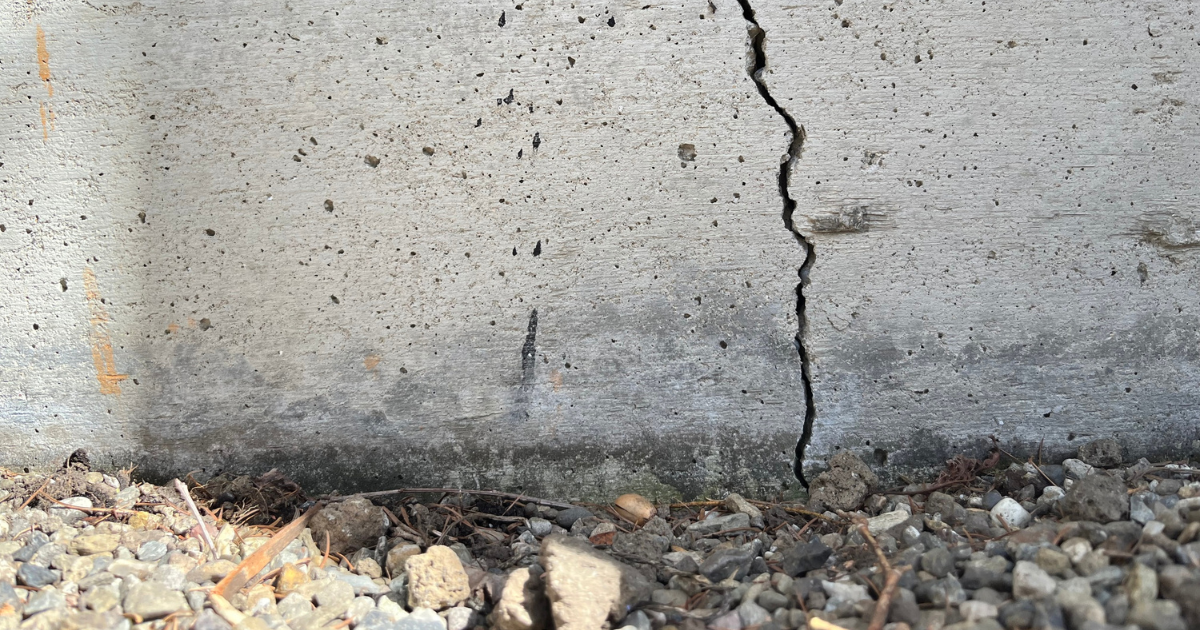
Common warning signs in Colorado Springs are cracked basement slabs, cracked walls, and doors that stop closing right. Many of them point to soil movement, though how serious it is varies widely. The table below pairs each sign with what Colorado Geological Survey publications say it usually indicates.
| Warning sign | What it usually indicates | Source |
|---|---|---|
| Cracked basement or garage slab | Slab heave. Floors on grade are light and move first when clay swells. | CGS Special Publication 14 |
| Cracked basement drywall, sticking basement doors | A rising slab pushing on partition walls. Often fixed by restoring the gap under the wall and adjusting doors. | CGS 1996 (Colorado Springs/Pueblo practice) |
| Cracks in foundation walls or brick | Uneven movement of the foundation itself. Calls for an engineer's look. | CGS expansive soil page |
| Basement wall bowing or leaning inward | Lateral movement, more common on taller basement walls. May need bracing or buttresses. | CGS 1996 |
| Cracked driveway, sidewalk, or patio | Heave of exterior concrete. Common, and often not structural on its own. | CGS Special Publication 14 |
| Water pooling against the foundation, flat grading | A drainage problem feeding the clay. CGS recommends about 12 inches of fall in the first 10 feet. | CGS Special Publication 14 |
| Broken water or sewer lines | More severe movement. CGS lists pipe and sewer breakage at the serious end of swelling damage. | CGS Special Publication 14 |
| A corner that drops after heavy watering (east side) | Possible settlement in collapsible loess soil. | CGS 1996 |
A table cannot diagnose your house. The 1996 paper says recommendations for a specific structure should come from a registered professional engineer who practices geotechnical engineering and knows local conditions. If you are selling, that report also becomes part of what you disclose.
Do You Have to Disclose Foundation Problems in Colorado?
Yes, you should expect to disclose known foundation problems when you sell a Colorado Springs house. The Colorado Real Estate Commission's current Seller's Property Disclosure, form SPD19, asks about them directly. It was adopted August 5, 2025, with mandatory use from January 1, 2026 (Colorado Real Estate Commission, SPD19, August 2025).
What the SPD19 asks about foundations and soil
The form asks you to check "Yes" for problems "EVER EXISTING," not just current ones. Several items reach a foundation issue:
- Section A, item 1: structural problems with improvements.
- Section A, item 2: structural supports or reinforcements added.
- Section A, item 6: any settling, movement, cracking, heaving, or breakage of foundations, floors, interior walls, exterior walls, and driveways.
- Section N, item 7: sliding, settling, upheaval, movement, or instability of earth, or expansive soils.
- Section N, item 9: location within a governmentally designated geological hazard or sensitive area.
- Section R, item 1: written soils or engineering reports, with copies of the reports you hold.
Item A2 matters for anyone who already paid for piers or bracing. A repaired foundation is still something you disclose. The good part is that a documented repair with an engineer's sign-off often reassures buyers.
The catch-all rule
The SPD19 also warns that failing to disclose a known adverse material fact "may result in legal liability." It says such a fact must be disclosed "whether there is a specific item on this SPD or not." Whether your contract requires the form or not, telling any buyer what you know is the safer course. A Colorado real estate attorney can review your specific answers.
The builder-only swelling soil statute
Colorado has a separate soils disclosure law, but it applies to builders, not to you as a resale seller. Under C.R.S. 6-6.5-101, a developer or builder must give the buyer of a new residence a summary of the soils analysis at least 14 days before closing. Where expansive soil is likely, the builder must also hand over a publication on the problem and how to care for the house.
If you bought new, look for that packet in your closing files. A builder's soils report is likely the kind of written report the SPD19 asks you to share. It can also save an engineer time when you get a repair estimate.
Why Lenders Can Require an Engineer's Report
Lenders can require an engineer's report because federal loan rules make the foundation part of the loan decision. For an FHA loan, HUD Handbook 4000.1 says the lender "must confirm that all foundations will be serviceable for the life of the Mortgage" (HUD Handbook 4000.1, November 2025 update).
What the appraiser has to report
The same handbook tells the FHA appraiser to examine the foundation for "readily observable evidence of safety or structural deficiencies." If the appraiser cannot confirm the house meets HUD's minimum standards, an inspection by a qualified person may be required. The handbook's list of triggers includes:
- standing water against the foundation or excessively damp basements
- evidence of possible structural failure, such as settlement or a bulging foundation wall
- cracked masonry walls or foundation
For a foundation, that qualified inspection is usually a structural engineer's letter. The loan then waits for the letter, and often for the repair it describes.
Three checkpoints where a financed sale can stall
A financed buyer's sale can stall at the inspection, the engineer's report, or the appraisal. The inspector may flag cracks and recommend an engineer. The engineer may write a repair plan with a real cost. The appraiser may value the house subject to repairs, which pushes the work back onto you before closing.
None of this means a financed buyer will walk away. It means more places for the sale to slow down or fall apart, and that uncertainty is often the hardest part.
Foundation Repair Options and Costs in Colorado Springs
Foundation repair in Colorado Springs ranges from regrading a yard to underpinning the whole house, and the cost follows the scope. Colorado Geological Survey sources describe the main approaches local engineers use.
Drainage and landscaping fixes
The cheapest fix is often the first one. The 1996 paper says movement can often be minimized when irrigation is corrected and surface drainage is improved. Special Publication 14 adds simple rules: keep sprinklers and plantings at least 5 feet from the foundation and trees at least 15 feet away.
Slab and basement wall repairs
Many Colorado Springs problems are slab problems, not foundation problems. The 1996 paper says most issues on expansive soil relate to slab movement and to basement partition walls built without a gap. It says these can generally be corrected by recreating that gap and adjusting doors. A slab that has dropped is sometimes lifted by slab jacking, which pumps material under the concrete.
Structural floors
Where swelling is severe, engineers may recommend a structural floor instead of a slab on grade. A structural floor is a framed floor that spans over the soil instead of resting on it. The 1996 paper says structural wood floors add cost but eliminate the risk of slab movement.
Underpinning with piers
For major foundation movement, the usual fix is underpinning. The 1996 paper describes drilled piers placed next to the foundation walls, with a concrete haunch to support the wall. It also describes helical screws, driven to refusal and fastened to the walls with steel brackets. Walls that have moved sideways may need steel angles, buttresses, or counterforts.
Why there is no price list here
Foundation repair cost in Colorado Springs depends on the soil, the depth to bedrock, the number of piers, and access around the house. A drainage fix and a full underpinning job can differ by a wide margin. The reliable way to price your repair is an engineer's report first, then written estimates based on that report.
Repair, List As-Is, or Sell for Cash: Which Path Fits?
The best path depends on the size of the repair, your cash on hand, and how much uncertainty you can carry. Repairing first may net the most when the fix is modest. Selling as-is for cash trades some price for speed and certainty. Listing as-is sits in between.
| Path | Timeline | Upfront cost to you | Who needs the engineer report | Certainty |
|---|---|---|---|---|
| Repair, then list | Engineering, estimates, and repair, then the listing period | The engineer and the repair, paid before you sell | You, to scope the work; buyers will want the repair records | Good once the repair is documented, but inspection can still reopen price |
| List as-is to financed buyers | The listing period plus the loan process, which can add steps | Little upfront; commissions and any price concessions come at closing | The buyer and the lender, often after the inspection or appraisal | Lowest; inspection, engineer, and appraisal can each stall the deal |
| Sell as-is for cash | Often as few as 7 days, or the closing date you choose | None; no repairs and no fees to Propcash | No one is required to order one; you share any reports you already have | Highest of the three; no loan or appraisal contingency |
When repairing first makes sense
If the engineer's plan is mostly drainage, slab work, or a few piers you can afford, repairing first may net you more. A documented repair lets FHA and conventional buyers move ahead. In that case, a listing may be the right call, and the ways to sell a Colorado Springs house for cash may matter less.
When an as-is sale makes sense
An as-is sale often fits when the repair is large, the estimate is uncertain, or the money is not there. It also fits when you have already moved or simply want to be done. You avoid paying for work on a house you will not live in.
Market conditions matter, too. The typical Colorado Springs house value was about $439,500 in September 2026, down about 1.5% from a year earlier (Zillow ZHVI, September 2026). Our Colorado Springs housing market 2026 guide covers what buyers are paying now.
How to Sell a House With Foundation Problems in Colorado Springs As-Is
To sell a house with foundation problems in Colorado Springs as-is, you share what you know, get a cash offer, and pick a closing date. You do not order repairs, and you do not need a lender's sign-off. As-is means as-is.
Step 1: Gather what you have
Pull together any engineer's letters, repair invoices, warranties, and builder soils reports. You do not need to commission a new report to get an offer. Sharing what you already have helps any buyer understand the house, and it supports your disclosure.
Step 2: Get a cash offer
Propcash is a direct cash homebuyer, so we buy the house ourselves. You can request a cash offer on your Colorado Springs house in about two minutes. We'll make you one transparent offer based on local market data, and we'll show you how we got to our number.
Step 3: Choose your closing date
Without a loan or appraisal, closings can happen in as few as 7 days. You can also pick a later date if you need time to move. There are no agent commissions and no fees to Propcash.
Our offer stands while you think it over. There is no aggressive follow-up. If a cash sale is not your best move, we will tell you so.
Foundation trouble is one of several repairs that can leave a Colorado Springs owner stuck. Roof and siding damage is another, covered in our guide to selling a house with hail damage in Colorado Springs. For how the local process works from start to finish, see our Colorado Springs cash buyer page or our overview of selling a house that needs major repairs.
Why wait? Sell your house “as is” for cash today
Tell us about your house. We'll make you a cash offer based on local market data.
Let's chatFrequently Asked Questions
Can you sell a house with foundation problems in Colorado Springs?
You can sell a house with foundation problems in Colorado Springs. It can be repaired and listed, listed as-is, or sold as-is to a cash buyer. In each case, you share what you know about the foundation with the buyer. The right path depends on the size of the repair, your budget, and how much time you have.
Do I have to disclose a foundation problem that was already repaired?
On the current Colorado Seller's Property Disclosure (SPD19), the answer is generally yes. The building conditions section asks about problems that ever existed, including structural supports or reinforcements added and any settling, movement, cracking, or heaving of foundations. A documented repair with an engineer's sign-off is often a selling point, so share the paperwork with the disclosure.
Is expansive soil common in Colorado Springs?
Expansive soil is common in Colorado Springs. A Colorado Geological Survey paper on engineering practice in Colorado Springs and Pueblo says the clay soils there are typically expansive to some degree. It adds that the Pierre Shale and the claystone of the Dawson formation can usually be expected to have moderate to very high swelling potential.
Will an FHA buyer's lender require an engineer's report on the foundation?
An FHA buyer's lender can require an engineer's report on the foundation. HUD Handbook 4000.1 requires the lender to confirm that all foundations will be serviceable for the life of the mortgage. It lists evidence of possible structural failure, such as settlement or a cracked foundation, among the conditions that may require an inspection by a qualified individual. In practice, that inspection is usually an engineer's report.
How much does foundation repair cost in Colorado Springs?
There is no single honest number, because the cost depends on what is moving and why. A drainage fix, a basement slab repair, and a full underpinning job are very different projects. The reliable way to price your house's repair is an engineer's report followed by written estimates based on that report.
Should I fix the foundation before selling my Colorado Springs house?
If the engineer's fix is small and affordable, repairing first may net you more, because a documented repair lets financed buyers proceed. If the fix is large, uncertain, or beyond your budget, an as-is sale avoids paying for work you will not live with. Compare the net from each path before you decide.
Sources: Colorado Geological Survey (expansive soil hazard page; Special Publication 14; Geologic Hazards and Engineering Practices in Colorado, 1996; Map Series 32), Colorado Real Estate Commission SPD19, C.R.S. 6-6.5-101, HUD Handbook 4000.1, and Zillow ZHVI. Propcash is a direct cash homebuyer, not a law firm or engineering firm. Talk to a Colorado real estate attorney about disclosure and a licensed engineer about your foundation.