
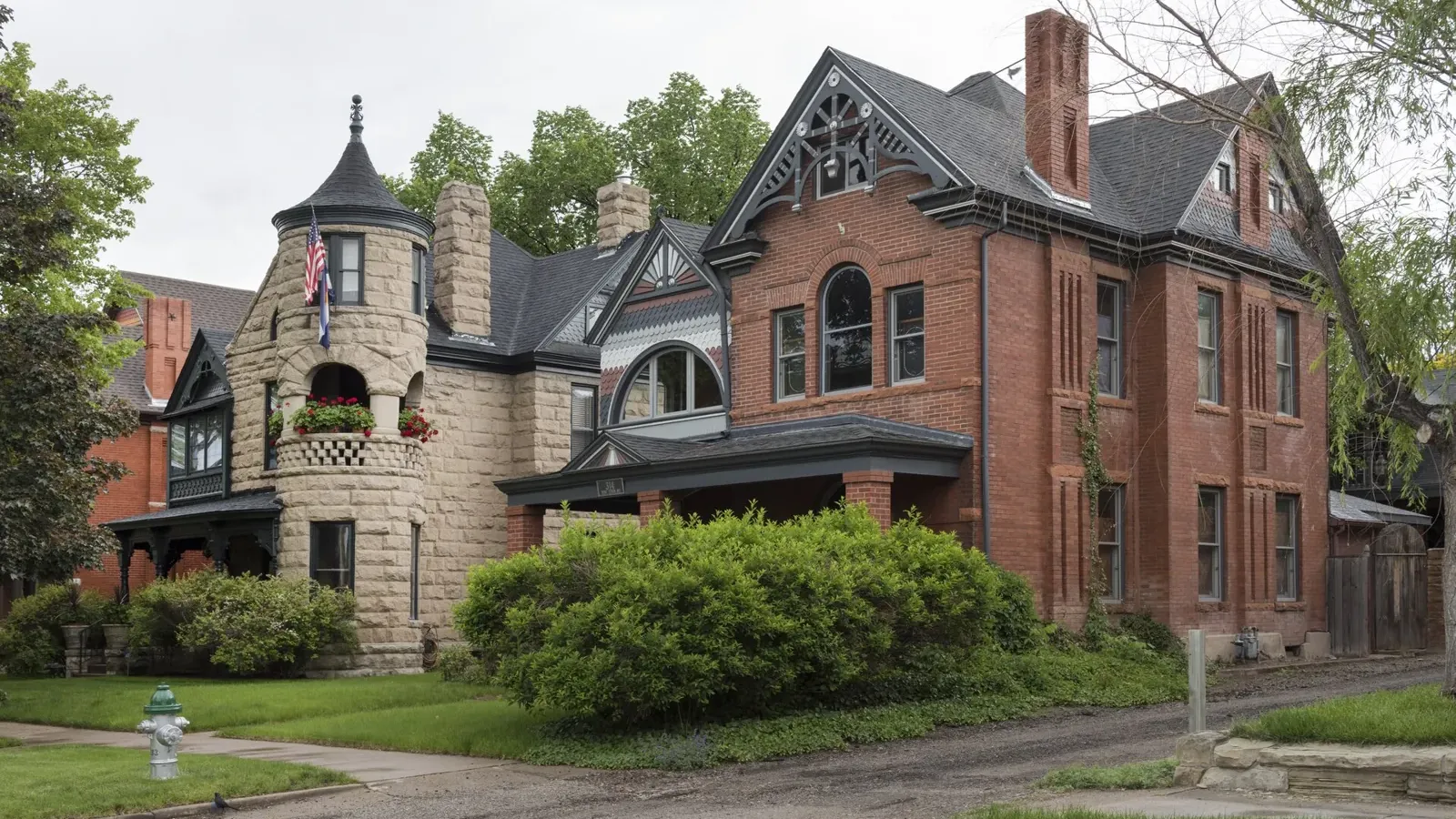
Pitkin Place Historic District, Pueblo. Photo by Carol M. Highsmith (public domain).
Key Takeaways
- Age alone does not trigger review: Pueblo's historic rules apply to designated landmarks and to contributing houses in designated districts, such as the North Side Historic District and Pitkin Place.
- Selling needs no historic approval: The Certificate of Appropriateness covers permitted work on a designated house (Pueblo Municipal Code Sec. 4-14-11), not the sale itself.
- Like-for-like repair is exempt: Work that restores a designated house to its prior condition does not need a certificate under Sec. 4-14-11(d).
- Pre-1978 houses carry a federal disclosure: Sellers must give the EPA lead pamphlet and disclose known lead-based paint, as-is or not (40 CFR 745.107).
- Lenders look hard at old systems: An FHA appraiser must test the plumbing, heating, and electrical systems and can condition the loan on repairs (HUD Handbook 4000.1).
- You have three real paths: renovate then list, list as-is, or sell as-is for cash. A well-kept historic house may do well listed.
If you want to sell an old house in Pueblo, Colorado, start with two questions. Is the house under the City's historic review, and what will a buyer's inspection turn up? North Side and Mesa Junction houses carry more than a century of Pueblo history. Their wiring, pipes, and heating often carry some of that age too.
This guide covers the City's historic rules, common older-house repairs, disclosure, and three ways to sell. A well-kept house may do best listed. If the repair list has you stuck, selling as it stands is also an option.
Why wait? Sell your house “as is” for cash today
Tell us about your house. We'll make you a cash offer based on local market data.
Let's chatWhat Makes North Side and Mesa Junction Houses Different?
North Side and Mesa Junction houses are some of Pueblo's oldest, with many built between the 1870s and 1950 for the city's merchants, professionals, and mill managers. That age gives them character, and it means inspectors look closely at systems patched or left original over decades.
The North Side: two neighborhoods in one
The City of Pueblo's Northside Historic Context Study, completed in May 2007, produced "an inventory of 347 properties" in its first phase. Of those, 24 were judged eligible for the National Register of Historic Places and 43 for the Pueblo Register (City of Pueblo, Northside Historic Context Study).
The study found two distinct neighborhoods. South of West 15th Street, the houses are "on average older (circa 1870-1910) and smaller." Between 15th and 19th Streets, the period of significance runs from about 1890 to 1950.
Mesa Junction and Pitkin Place on the South Side
Mesa Junction is part of the old South Pueblo neighborhood, and its Victorian houses help define it. The City's inventory describes the 1886 J.A. Wayland House at 330 Colorado Avenue as "a fine example of a Queen Anne style residence." It lists the 1891 Galligan House at 501 Colorado Avenue as a Late Victorian Queen Anne (City of Pueblo HPC, Inventory of Cultural Resources, September 2020).
Nearby, Pitkin Place lines the south side of the 300 block of West Pitkin Avenue. In the early 1890s, the architect-contractor team of George Roe and E.W. Shutt built six of its seven houses. The Colorado Fuel and Iron Company owned the land.
Is Your House in a North Side Historic District or Other Local Designation?
Your house falls under Pueblo's local historic review only if the City has designated it as a landmark or it sits in a designated historic district; age alone does not trigger review. An older house with no designation needs no historic certificate. Ordinary building permits still apply to work on it.
The North Side Historic District
The City calls the North Side Historic District Pueblo's only local register residential historic district. It holds 79 contributing houses, 22 from phase 1 and 57 from phase 2. The City describes it as Pueblo's "merchant prince" neighborhood, set away from the smoke of the steel mill (City of Pueblo HPC, September 2020).
The district is generally located from Court Street to West Street and from 17th to 19th Streets. The City's address list also includes several houses on West 20th Street, so the street grid alone will not settle it. The same list shows both contributing and noncontributing addresses inside the district.
Pitkin Place and individual landmarks
The seven Pitkin Place houses appear on the City's list of addresses subject to local regulations, as part of the Pitkin Place Historic District. Individual houses can also be landmarks on their own. The Wayland and Galligan houses in Mesa Junction both appear on that list as local landmarks.
When a National Register listing counts locally
A National Register listing does not, by itself, put every house under city review. Pueblo's code adds National Register listings made with the owner's consent to the local inventory as landmarks or districts (Pueblo Municipal Code Sec. 4-14-8(l)). The City's inventory notes that listings made before 1981 were folded in the same way.
| Your house's status | What review applies | What it means when you sell |
|---|---|---|
| Designated local landmark | Certificate of Appropriateness before permitted alterations; restoring repair is exempt (Sec. 4-14-11) | No approval to sell; the buyer inherits the same review |
| Contributing house in the North Side or Pitkin Place district | Same certificate rule; the code's "element" means a contributing building | No approval to sell; tell buyers about the district |
| Noncontributing address inside a district | Listed by the City; confirm with staff how review applies | Ask staff in writing and share the answer with buyers |
| National Register listing made with owner consent | Added to the local inventory, so local rules apply (Sec. 4-14-8(l)) | Treat it like a landmark for planning work |
| Older house with no designation | No historic certificate; ordinary building permits only | Condition and disclosure drive the sale |
The City's Historic Preservation Commission works through the Planning Department. You can reach staff at HPC@Pueblo.us or 719-553-2259 (City of Pueblo HPC). Ask whether your address is a landmark, a contributing house, or neither, and keep the reply for your buyer.
What a Certificate of Appropriateness Means for a Sale
A Certificate of Appropriateness is the City's sign-off on certain work to a designated house, and Pueblo's code does not require one to sell. The rule targets alteration, construction, restoration, rehabilitation, or relocation that needs a building permit. It also reaches unpermitted work that would harm the qualities that earned the designation.
What the code says
Under Sec. 4-14-11(c), no owner may carry out that work on a designated landmark or an element within a designated district "without prior issuance of a Certificate of Appropriateness therefor" (Pueblo Municipal Code Sec. 4-14-11). Subsection (d) carves out ordinary repair. Work that fixes deterioration, decay, or damage to restore the house "to its condition prior to the occurrence of such deterioration" is not blocked.
Replacing a rotted porch board in kind differs from replacing original windows. Ask staff before any visible change.
How the review works
The owner files the application with the Planning and Community Development Department. It can call for plans, photographs, specifications, and material samples. The Commission hears a complete application at its next available monthly meeting (Sec. 4-14-12).
The Commission can approve, deny, or continue the application for up to 60 days with suggested changes. If it fails to act within 90 days of filing, the code treats the application as approved.
What happens if work skips review
A violation of the chapter is a Class 2 municipal offense with a fine of up to $1,000, and each day counts as a separate violation (Sec. 4-14-18). The code also requires designated houses to be maintained to the standards in other parts of the City code (Sec. 4-14-16). If past owners made changes without review, tell buyers what you know rather than guessing.
New windows, siding, porch rebuilds, and roof material changes on a designated house can all raise review questions. A project started without a needed certificate can leave the next owner with a problem to sort out. One email to city staff is cheaper than undoing work.
Which Repairs Come Up When You Sell an Older Pueblo House?
The repairs that tend to come up when you sell a house that needs repairs in Pueblo are older wiring, aging plumbing and sewer lines, worn heating equipment, lead-based paint, and foundation wear. Not every older house has these issues, and records of past updates help any sale.
Wiring
A house built before 1950 may still have early wiring in its walls, mixed with newer circuits added over time. Buyers and their lenders want proof that it works and is safe.
Plumbing and sewer lines
Supply pipes and the sewer line to the street are often as old as the house, or close to it. A buyer may ask for a camera inspection of the sewer line. Disclose any slow drains or past backups you know about.
Boilers and older furnaces
Some older houses still heat with a boiler and radiators. Others have furnaces that have outlived their expected service life. An appraiser or inspector will want to see the heat run, and a cold or shut-off system raises questions.
Lead-based paint
Any house built before 1978 may have lead-based paint under newer coats. Federal rules call this "target housing" and require a specific disclosure when it sells (40 CFR 745.103).
Foundations and masonry
Older foundations can show cracks, settling, or worn mortar after a century of freeze and thaw. An engineer's letter, if you have one, gives buyers something firm to work from.
What You Have to Disclose About an Older House
When you sell an older Pueblo house, you have to disclose known adverse facts on Colorado's seller disclosure form and, for a house built before 1978, give the federal lead-based paint disclosure. Selling as-is does not remove either duty.
Colorado's seller disclosure form
The Colorado Real Estate Commission's Seller's Property Disclosure (SPD19) warns that failing to disclose a known adverse material fact "may result in legal liability." It adds that such a fact must be disclosed "whether there is a specific item on this SPD or not" (Colorado Division of Real Estate, SPD19). Our guide to Colorado seller disclosure requirements walks through the form.
The federal lead-based paint rules
Before a buyer is bound by the contract, the seller must give the EPA pamphlet "Protect Your Family From Lead in Your Home." The seller must also disclose any known lead-based paint or hazards and hand over any reports in hand (40 CFR 745.107). You do not have to test or remove anything.
The buyer also gets a 10-day period to test for lead, unless both sides agree in writing to a different period. A buyer can waive that chance in writing (40 CFR 745.110).
How Buyer Financing Treats Older Systems
Buyer financing can add repair conditions to an older house, because an FHA appraiser must test the plumbing, heating, and electrical systems and flag defective paint on pre-1978 houses. Those conditions must be met before the loan closes.
What an FHA appraiser checks
HUD Handbook 4000.1 says the appraiser "must observe the physical condition of the plumbing, heating and electrical systems" and operate them. If the systems appear damaged or not working, the appraiser "must condition the appraisal for repair or further inspection" (HUD Handbook 4000.1, November 2025 update). Electrical, plumbing, or heating certifications may be required.
For houses built before 1978, the appraiser must note the condition and location of all defective paint and require repair. That covers cracking, scaling, chipping, peeling, or loose paint on porches, railings, windows, doors, and outbuildings.
Vacant houses with the utilities off
If the utilities are off, the appraiser must ask to have them turned on. If that is not feasible, the appraisal is made subject to a second visit, and that visit "may result in additional repair requirements." This comes up often with estate houses. If you inherited the house, our guide to selling an inherited house in Pueblo covers probate and the City's vacant house rules.
Renovate, List, or Sell a House As-Is in Pueblo?
The right path depends on the house's condition, your budget, and your time: renovating can widen the buyer pool, listing as-is keeps the agent route open, and a cash sale skips repairs and lender conditions.
For context, Redfin reports a median sale price of $260,676 in Pueblo for the three months ending September 2026, down 0.69% from a year earlier. Houses sold after a median of 62 days on the market, compared with 56 days the year before (Redfin, September 2026).
Zillow measures something different. Its Home Value Index puts the typical Pueblo value at $281,571 as of September 2026, down 2.36% year over year (Zillow ZHVI, September 2026). Neither figure tells you what a specific older house will bring. Condition, historic status, and the street matter more.
| Factor | Renovate, then list | List as-is | Sell as-is for cash |
|---|---|---|---|
| Repairs before the sale | You plan, fund, and manage them | None up front; buyers may ask later | None |
| Historic review | May need a certificate for exterior work on a designated house | None for the sale | None for the sale |
| Lender conditions | Fewer, if systems are updated | Possible on FHA and other loans | None; no lender appraisal |
| Showings and inspections | Yes | Yes | One walkthrough, typically |
| Agent commissions | Usually yes | Usually yes | None with Propcash |
| Timeline | Repair time plus market time | Market time plus loan closing | Can close in as few as 7 days |
| Best fit | Owners with time, funds, and a clear repair plan | Well-kept houses with modest issues | Owners who want certainty and no repairs |
When listing makes sense
A well-kept historic house with updated systems may sell well on the open market. Buyers often look for original woodwork, tall ceilings, and a porch on a tree-lined street. If that describes your house and you have time, an agent who knows older Pueblo houses may net you more.
When selling as-is makes sense
Selling as-is fits when the repair list is long, the budget is short, or the house is empty and costing money each month. As-is means as-is: the house sells in its current condition, with nothing to fix first.
How to Sell an Old House in Pueblo As It Stands
To sell an old house in Pueblo as it stands, gather what you know, confirm its historic status, and get a cash offer you can compare with your other options.
Step 1: Gather what you know
Pull together receipts for past work, any inspection or engineer reports, and lead test results. Write down known issues in plain words for your disclosure.
Step 2: Confirm the house's status
Ask city staff whether the house is a landmark, a contributing house, or neither, and keep the reply for buyers.
Step 3: Get a cash offer and compare
Propcash is a direct cash homebuyer that buys older Pueblo houses in their current condition. We make one transparent, data-backed cash offer and show the reasoning behind it. There are no fees or commissions, and you choose the closing date. You can request a cash offer on your house in about two minutes, or read more about selling a house fast in Pueblo.
The Propcash Promise is simple. Our offer stands while you weigh it, there is no aggressive follow-up, and if we are not the right buyer, we will say so. For more on selling with deferred repairs, see our page on selling a house that needs major repairs.
Why wait? Sell your house “as is” for cash today
Tell us about your house. We'll make you a cash offer based on local market data.
Let's chatFrequently Asked Questions
Do I need city approval to sell a house in Pueblo's North Side Historic District?
You do not need city approval to sell a house in Pueblo's North Side Historic District, because the City's historic preservation code reviews work on a house, not its sale. The Certificate of Appropriateness in Sec. 4-14-11 applies to permitted alterations and similar work on a landmark or a contributing house. Whoever buys the house takes on the same review for any future work.
Is my Pueblo house under historic review just because it is old or on the National Register?
An old Pueblo house is not under local historic review because of its age, and a National Register listing brings it under city review only when the listing had the owner's consent. Sec. 4-14-8(l) adds those consented listings to the Pueblo Inventory of Cultural Resources as landmarks or districts. City staff at HPC@Pueblo.us or 719-553-2259 can confirm the status of a specific address.
Can I repair my North Side house without a Certificate of Appropriateness?
You can repair deterioration, decay, or damage on a designated Pueblo house without a Certificate of Appropriateness when the work restores the house to its prior condition. Sec. 4-14-11(d) says the certificate rule does not prevent that kind of repair. Changing materials, design, or exterior features is a different matter, so ask city staff before that work starts.
Do I have to disclose lead-based paint when selling a pre-1978 Pueblo house?
You have to give the federal lead-based paint disclosure when you sell a Pueblo house built before 1978, even in an as-is sale. The rules require the EPA lead pamphlet, disclosure of any known lead-based paint or hazards, and copies of any reports you have (40 CFR 745.107). The buyer also gets a 10-day window to test, unless the buyer waives it in writing.
Can I sell an older Pueblo house as-is without fixing the wiring or heating?
You can sell an older Pueblo house as-is without fixing the wiring or heating, as long as you disclose what you know about it. A buyer using an FHA loan may face appraisal conditions on systems that do not work, which can slow or stop that sale. A cash buyer does not need a lender's appraisal, so the house can sell as it stands.
How fast can a cash sale of an older house in Pueblo close?
A cash sale of an older house in Pueblo can close in as few as 7 days, because there is no lender appraisal or underwriting to wait on. Title work and your own schedule still shape the actual date. With Propcash, you pick the closing date, and a later date is fine if you need time to move.