
Key Takeaways
- The cause is a mineral, not settling: pyrrhotite in the aggregate oxidizes and breaks the concrete apart from inside. CFSIC states the damage is irreversible and full replacement is the most effective remediation.
- The risk zone is defined: upwards of 35,000 houses in a radius of Stafford Springs face the potential for a failed foundation. Testing reimbursement covers houses built January 1, 1983 through December 31, 2015 (Connecticut Department of Housing, read September 2026).
- CFSIC is the funding source: the cap rose January 20, 2026 to $205,000 per stand-alone house and $82,000 per condominium unit. Applications close 5:00 PM on June 30, 2030 (CFSIC, February 2, 2026).
- Assistance follows owner-occupants: a Type 1 claimant who bought on or after October 31, 2017 signs a Twelve-Month Residency Agreement, and CFSIC excludes business buyers of distressed properties.
- Disclosure is a form: Connecticut's Residential Property Condition Report asks about knowledge of pyrrhotite, and skipping it costs the seller a $500 credit at closing (Conn. Gen. Stat. § 20-327c).
- Your assessment can come down: an engineer's evaluation of defective concrete triggers a municipal reassessment within ninety days (Conn. Gen. Stat. § 29-265d).
Selling a house with a crumbling foundation in Connecticut is a different problem from selling a house that needs a roof. The concrete itself is failing, the repair is a full foundation replacement, and the state has built a set of programs around it.
This guide covers what decides the outcome: how a pyrrhotite foundation in Connecticut gets confirmed and classified, and what CFSIC pays. It also covers what you must disclose, how to get your assessment adjusted, and the three realistic paths to a sale. Propcash buys houses as-is, unrepaired foundations included.
What Pyrrhotite Does to a Connecticut Foundation
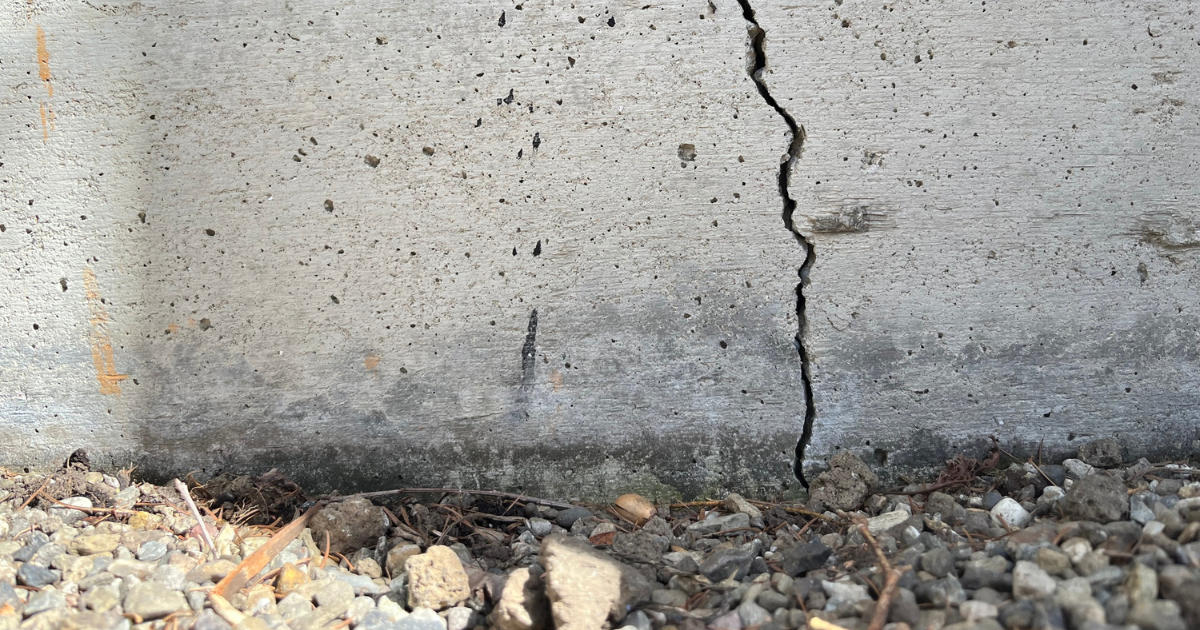
Pyrrhotite is a naturally occurring iron sulfide mineral that sits inside some stone aggregate, and when that aggregate ends up in concrete it slowly destroys the foundation from within. CFSIC describes the chemistry plainly. Pyrrhotite oxidizes in the presence of water and oxygen, forms expansive mineral products, and causes the concrete to deteriorate prematurely (CFSIC Underwriting and Claims Management Guidelines, modified January 20, 2026).
The failure is progressive. CFSIC notes that a deteriorating foundation often becomes unsound, that a rust color or white powder may appear, and that the damage is irreversible.
That last word is why this does not behave like other repairs. No injection, coating, or pier system reverses it. CFSIC states that the most effective remediation is replacing the foundation with one that does not contain pyrrhotite, which means lifting the house, removing the concrete, and pouring again. Engineers look for map-pattern cracking that spreads across a wall, not the one-direction settlement crack that stays local.
Which Connecticut Houses Are at Risk for a Crumbling Foundation?
The risk concentrates in north-central and eastern Connecticut, in houses poured with aggregate from one quarry area. The Department of Housing counts upwards of 35,000 houses in a radius of Stafford Springs (Connecticut Department of Housing, Crumbling Foundations, read September 2026). CFSIC, working from its own claim data, writes that perhaps as many as 30,000 houses across approximately 41 towns may be affected (CFSIC guidelines, modified January 20, 2026).
The date range and the map
The state's testing reimbursement program treats a house as eligible if it was built on or after January 1, 1983 and before December 31, 2015 (Connecticut Department of Housing, read September 2026). If the house predates 1983 but an addition went up in those years, the addition's foundation can qualify. The house or addition must also sit within 20 miles of the former J.J. Mottes Concrete Company in Stafford Springs.
CRCOG publishes the list of municipalities determined to be affected, or potentially affected, by crumbling foundations for real estate transactions on its crumbling foundations page. The area rings the north edge of Hartford County and runs east through Tolland County, inside the greater Hartford cash home buyer footprint.
How Do You Confirm a Crumbling Foundation, and What Does Testing Cost?
Confirmation starts with a visual inspection by a Connecticut-licensed professional engineer. The state reimburses 100% of that cost up to $400, plus 50% of core testing up to $2,000 (Connecticut Department of Housing, read September 2026). CRCOG administers the reimbursement through foundationtesting.org.
The two tests answer different questions. A visual inspection is an engineer's opinion that the cracking comes from incompatible materials in the mix. A core test pulls a sample and reports whether pyrrhotite is present and at what percentage.
The severity classes drive everything downstream
The engineer or CFSIC-certified home inspector assigns a severity class, and that code sets your position in line. CFSIC's guidelines define three:
- Severity Class 3: cracking associated with pyrrhotite-bearing aggregate, typical widths greater than 1.0mm, covering more than 20% of any contiguous wall plane.
- Severity Class 2: the same cracking, typical widths of 1.0mm or less, covering less than 20% of any contiguous wall plane.
- Severity Class 1: no visual indications. A Class 1 claim also needs a core sample whose laboratory report finds pyrrhotite before CFSIC will consider it.
CFSIC funds Class 3 claims first, then Class 2, as they become active. For stand-alone houses that ordering has held since the program opened on January 10, 2019.
Take a house purchased on or after February 1, 2019 and built in 1983 or later. CFSIC's guidelines make the buyer eligible to apply only if the buyer or the seller had testing or a qualifying visual exam before the sale date. Ordering the inspection preserves the buyer's access.
CFSIC: What the Program Pays and What It Asks of You
The Connecticut Foundation Solutions Indemnity Company is a state-created captive that pays for foundation replacement, and it is the only broad source of remediation money for affected owners. It is a private, tax-exempt corporation funded from two sources: an annual allotment from the Crumbling Foundations Assistance Fund, and a $12 per year assessment on each Connecticut homeowners policy. CFSIC reports receiving more than $266 million from them (guidelines modified January 20, 2026).
Type 1, Type 2, and the deadlines
A Type 1 claim is replacement assistance: the foundation is compromised, and CFSIC funds the eligible costs of replacing it. A Type 2 claim reimburses an owner who already paid for a replacement.
Type 2 is closing. CFSIC's board voted to wind it down beginning September 15, 2026, ceasing entirely on March 15, 2027 (CFSIC, August 31, 2026). CFSIC has handled 116 active Type 2 claimants against a lifetime cap of 125, and reports the wait to open a new Type 1 application now runs under 120 days.
Effective January 20, 2026, the cap on CFSIC allowable concrete costs rose from $190,000 to $205,000 for stand-alone houses, and from $76,000 to $82,000 per condominium unit (CFSIC, February 2, 2026). Eligibility for the higher cap turns on the contractor proposal date, not the application date. New applications close at 5:00 PM on June 30, 2030.
CFSIC reached its 1,500th claimant in early 2026. Its published facts and figures put claims covered by participation agreements at 1,551 and construction paid at $183,831,709. The average Type 1 remediation runs $138,967 in allowable costs (CFSIC, crumblingfoundations.org, read September 2026), and its broader cost guidance runs $150,000 to $250,000 per building.
The strings attached
A Type 1 claimant who bought on or after October 31, 2017 must sign a Twelve-Month Residency Agreement. It promises the claimant will own and live in the house for at least twelve months after the certificate of completion or occupancy issues.
CFSIC's guidelines also state that a company purchasing distressed residential properties as a business cannot qualify as a claimant, apart from narrow condominium situations. A cash buyer cannot step into the program for you.
And a Type 1 claim does not go active until you produce written evidence from a current or prior homeowner's insurer that a foundation claim was denied, accepted, or is pending.
The Assistance Programs Side by Side
Five programs touch a Connecticut crumbling foundation, each with its own cap and clock, as of September 2026.
| Program | What it covers | Cap | Deadline or timing |
|---|---|---|---|
| CFSIC Type 1 (replacement assistance) | Allowable concrete costs of replacing a compromised foundation, paid to a contractor you pick from CRCOG's qualified list | $205,000 per stand-alone house; $82,000 per condo unit (proposals dated and submitted on or after January 20, 2026) | Applications close 5:00 PM, June 30, 2030 |
| CFSIC Type 2 (reimbursement) | Reimbursement to an owner who already paid to replace a compromised foundation | Same $205,000 and $82,000 caps; 125 Type 2 claims total for the life of the program | Winddown begins September 15, 2026; category ceases March 15, 2027 |
| DOH testing reimbursement (administered by CRCOG) | Visual inspection by a Connecticut-licensed professional engineer, and core testing | 100% up to $400 for a visual inspection; 50% up to $2,000 for core testing | House built January 1, 1983 to December 31, 2015, within 20 miles of Stafford Springs; confirm funding with CRCOG |
| Supplemental Collapsing Foundation Loan (CHFA) | Repair costs outside what CFSIC funds: framing, drywall, paint, porches, decks, gutters, landscaping | Up to $75,000, term up to 20 years; $20 million total across the program | Requires a CFSIC participation agreement first; lender participation is voluntary |
| Municipal reassessment | Adjusts the assessed value to reflect what the house is worth with a defective concrete foundation | No dollar cap; the assessor sets current value | Assessor acts within ninety days of the engineer's evaluation, or before the next assessment year |
Sources: CFSIC news posts of February 2 and August 31, 2026; Connecticut Department of Housing and the Connecticut Department of Banking, read September 2026; Conn. Gen. Stat. § 29-265d.
Why Can't a Financed Buyer Close on a Class 2 or Class 3 Foundation?
A mortgage lender is buying collateral, and a foundation coded Class 2 or Class 3 is collateral with a known, documented, six-figure defect. The appraiser reports the condition, the underwriter reads the engineer's report attached to the disclosure, and the loan stalls. Insurance is the second wall.
The U.S. Government Accountability Office reported that insurance companies have mostly denied pyrrhotite-related claims. It also found that affected homeowners may face remediation costs of $150,000 or more, and drops in property values of 25 percent or more (GAO-20-649, July 2020). GAO added that the extent of the problem is not fully known and federal options are limited.
Connecticut did close one gap. The Department of Housing states that insurers cannot cancel or refuse to renew a homeowner's policy because of a crumbling foundation. Keeping coverage in force is not the same as getting a claim paid.
For a seller that means a smaller buyer pool, not a closed door. Cash purchases involve no lender and no appraisal, which is why unrepaired foundations here tend to trade for cash, as they do across houses that need major repairs anywhere.
What Connecticut Requires You to Disclose
Connecticut requires the seller to give the buyer a written Residential Property Condition Report before the buyer signs a binder, purchase contract, option, or lease with a purchase option (Conn. Gen. Stat. § 20-327b). The foundation questions on it are specific.
The Building, Structure and Improvements section asks the seller:
- Is the foundation made of concrete?
- Are there foundation or slab problems?
- Has a licensed professional done foundation testing or an inspection?
- Have there been foundation repairs?
- Do you have any knowledge related to the presence of pyrrhotite in a foundation on the property?
Public Act 19-192 added those questions in 2019. Where a testing, inspection, or repair report exists, the statute directs the seller to attach a copy.
The Department of Consumer Protection publishes the form, currently revised 07/2025, which also carries the Flood Risk Awareness questions added by Public Act 25-33, effective July 1, 2025.
The $500 credit, and what it does not buy
A seller who fails to furnish the report credits the purchaser $500 at closing (Conn. Gen. Stat. § 20-327c). Treating that $500 as the price of skipping disclosure is a mistake. The credit does not excuse the seller from disclosing a known defect. That applies to any defect within the seller's actual knowledge that significantly impairs the property's value, the health or safety of future occupants, or its useful life. A purchaser may sue for actual damages.
A deteriorating pyrrhotite foundation is what that language was written for. Our guide to Connecticut seller disclosure requirements walks through the full form.
The separate Residential Foundation Condition Report
Connecticut also has a second, narrower form, the Residential Foundation Condition Report, added by Public Act 19-192 at § 20-327b(g) and (h). It asks three foundation questions. It applies in the municipalities CRCOG determines are affected, or potentially affected, by crumbling foundations. Within those towns it covers property the owner took title to through a political subdivision, strict foreclosure, foreclosure by sale, or a deed in lieu.
Most owner sellers never touch it. The statute also exempts several ordinary transfers from the report requirement entirely, including transfers by executors, administrators, trustees, and conservators.
Getting Your Assessment Reduced While the Foundation Is Failing
Connecticut lets you bring your assessment down to what the house is worth with a defective foundation, and the trigger is an engineer's report. Public Act 16-45 required municipal assessors to inspect and reassess residential properties with foundations made from defective concrete (Connecticut Department of Housing, read September 2026).
The current mechanics sit in Conn. Gen. Stat. § 29-265d, as amended by Public Act 21-120. An owner with an engineer's written evaluation indicating the foundation was made with defective concrete gives the assessor a copy and requests a reassessment. The assessor or a designee must then inspect and adjust the assessment to current value within ninety days, or before the next assessment year begins, whichever comes first.
The reassessment holds until the next revaluation takes effect, or until the foundation is repaired or replaced and the assessor adjusts again, whichever is earlier. It may be appealed to the board of assessment appeals under Conn. Gen. Stat. § 12-111.
This is worth doing even if you plan to sell, because a lower assessment cuts carrying cost every month. If tax arrears have already built up, our guide to Connecticut municipal tax sales covers what happens next.
Three Paths for Selling a House With a Crumbling Foundation in Connecticut
Three paths work, and the right one depends on how long you can stay, whether your claim is active, and how much disruption you can take.
| Path | What it takes | Tradeoffs |
|---|---|---|
| Replace the foundation, then sell | An active Type 1 claim, two contractor proposals, a participation agreement, the lift-and-pour construction, then the twelve-month residency period if you bought on or after October 31, 2017 | Restores a condition a financed buyer and insurer can work with. Slowest by far, requires you to live there through it, and costs above the cap fall to you |
| Sell with a CFSIC claim in place | An active claim established before the sale, an unreplaced foundation, and a buyer who will live in the house and sign the residency agreement | The new owner may assume your place in line, real value to the right buyer. Narrows the pool to owner-occupants, and financing is still difficult |
| Sell as-is for cash | The disclosure report, any engineer's report you have, clear title, and a closing attorney | No repairs, no contractor scheduling, no residency requirement, and you pick the date. A business buyer cannot claim CFSIC assistance, which shows up in the offer |
How an as-is cash sale works on an unrepaired foundation
Propcash is a direct cash homebuyer. We buy the house ourselves as the principal, so there is no lender to satisfy, no appraisal contingency, and no request that you fix the foundation first. Cash transactions can close in as few as 7 days, and you pick the closing date.
You still deliver the Residential Property Condition Report, and you should. A documented foundation is easier to price. If you have a visual inspection report with a severity class, a core test result, or a CFSIC claim number, send them when you submit your property.
Propcash makes one transparent, data-backed offer and explains how we got to our number. Sellers pay no fees or commissions, and there is no obligation. If a cash sale is not your best move, for example if your claim is nearly funded and you can stay through construction, we will say so. See our Connecticut cash home buyer page for how the process works.
Why wait? Sell your house “as is” for cash today
Tell us about your house. We'll make you a cash offer based on local market data.
Let's chatFrequently Asked Questions
Can you sell a house with a crumbling foundation in Connecticut?
Yes. Connecticut has no law barring the sale of a house with a deteriorating concrete foundation. What changes is the buyer pool, because many financed buyers cannot get a lender and an insurer comfortable with a foundation that is visibly failing. Sellers generally replace the foundation first, pass an active CFSIC claim position to an owner-occupant buyer, or sell as-is to a cash buyer.
Does Connecticut require you to disclose pyrrhotite when you sell a house?
Connecticut's Residential Property Condition Report asks whether the seller has any knowledge related to the presence of pyrrhotite in a foundation on the property, along with questions about foundation testing, inspections, and repairs (Conn. Gen. Stat. § 20-327b). A seller who does not furnish the report owes the buyer a $500 credit at closing under § 20-327c. That credit does not excuse failing to disclose a known defect that significantly impairs value, occupant health or safety, or useful life.
Will CFSIC pay for a foundation replacement if you plan to sell the house?
CFSIC assistance is built around owner-occupants rather than sellers. A Type 1 claimant who bought on or after October 31, 2017 must sign a Twelve-Month Residency Agreement. It promises the claimant will live in the house for at least twelve months after the certificate of completion or occupancy issues. CFSIC's guidelines also state that a company buying distressed residential properties as a business cannot qualify as a claimant, outside narrow condominium situations.
Can a buyer take over a seller's CFSIC claim?
In some cases, yes. Under CFSIC's guidelines, a house sold on or after October 31, 2017 can qualify if the selling owner had established an active claim and the foundation has not been replaced. The new owner may then assume the original owner's place in line. The new owner must sign the Twelve-Month Residency Agreement, so this path fits an owner-occupant buyer rather than a business buyer.
Does homeowners insurance cover a crumbling foundation in Connecticut?
Generally it has not. The U.S. Government Accountability Office reported in July 2020 that insurance companies have mostly denied pyrrhotite-related claims (GAO-20-649). CFSIC requires a Type 1 claimant to produce a written denial or acceptance from a current or prior homeowner's insurer before the claim goes active. The Connecticut Department of Housing separately states that insurers cannot cancel or refuse to renew a policy because of a crumbling foundation.
How fast can a cash sale close on a Connecticut house with a crumbling foundation?
Cash transactions do not require bank financing, an appraisal, or lender underwriting, so they can close in as few as 7 days once title work is clear. Connecticut closings still run through an attorney, and the seller still delivers the Residential Property Condition Report. Propcash lets the seller pick the closing date.
Data Sources: Connecticut Department of Housing; CFSIC; Capitol Region Council of Governments; Connecticut Department of Banking; Connecticut Department of Consumer Protection; Conn. Gen. Stat. §§ 20-327b, 20-327c, 12-111, and 29-265d; Public Acts 16-45, 19-192, 21-120, and 25-33; GAO-20-649. Propcash is a direct cash homebuyer, not a law firm or an engineering firm. Confirm program terms with CFSIC and consult a Connecticut-licensed attorney.