
Key Takeaways
- The ground is the cause: limestone sits at the surface across about 60% of Warren County (USGS), and Bowling Green is a listed karst city.
- Most local sinkholes are soil collapses: bedrock collapses like the 2014 Corvette Museum hole are rare.
- Form 402 asks directly: soil stability and drainage problems are answered "whether or not they have been corrected."
- Insurance and lenders are the choke points: standard policies generally exclude earth movement, and lenders balk at visible settlement.
- Local karst rules cover new development only: they do not retrofit existing houses.
- You have options: repair and list, list as-is, or get a cash offer on the house as it stands.
If you need to sell a house with a sinkhole in Bowling Green, the cause runs under the whole city. Warren County is built on limestone that water has been dissolving for ages. A dip in the yard, a basement that takes water after hard rain, or a crack that keeps coming back can make a sale feel stuck before it starts.
This guide covers what karst is, how local sinkholes form, what Kentucky's disclosure form asks, and why insurers and lenders hesitate. It also covers repairs and how to find out what your house could sell for as-is. For statewide rules, see the Kentucky seller disclosure requirements guide.
Why wait? Sell your house “as is” for cash today
Tell us about your house. We'll make you a cash offer based on local market data.
Let's chatWhat Is Karst, and Why Does Bowling Green Sit on It?
Karst is ground built on soluble rock, usually limestone, and most of Warren County sits on it. The Kentucky Geological Survey (KGS) describes karst as "areas with sinkholes, caves, and springs" (KGS, Karst FAQ, January 2023).
The U.S. Geological Survey maps the Ste. Genevieve and St. Louis Limestones at the surface across about 60% of Warren County. Other Mississippian rocks cover another 26% (USGS, Warren County geologic units, read September 2026).
About 55% of Kentucky is underlain by rock that could develop karst, and 25% has well-developed karst features (KGS, Where Is Karst Located in Kentucky?, January 2023). KGS lists Bowling Green among its Western Pennyroyal karst cities. Its advice: "you should assume that all limestone has karst development."
None of this has slowed growth. Warren County grew 11.0% from 2020 to 2025, the fastest of any Kentucky county (U.S. Census Bureau, Vintage 2025). More roofs and pavement send more water into the same limestone.
How Do Sinkholes Form Under Bowling Green Houses?
Most sinkholes around Bowling Green form when soil slumps or collapses into openings in the limestone below. True bedrock collapses are rare, and the difference shapes how big a hole gets and how it is fixed.
Cover-collapse sinkholes: the common kind
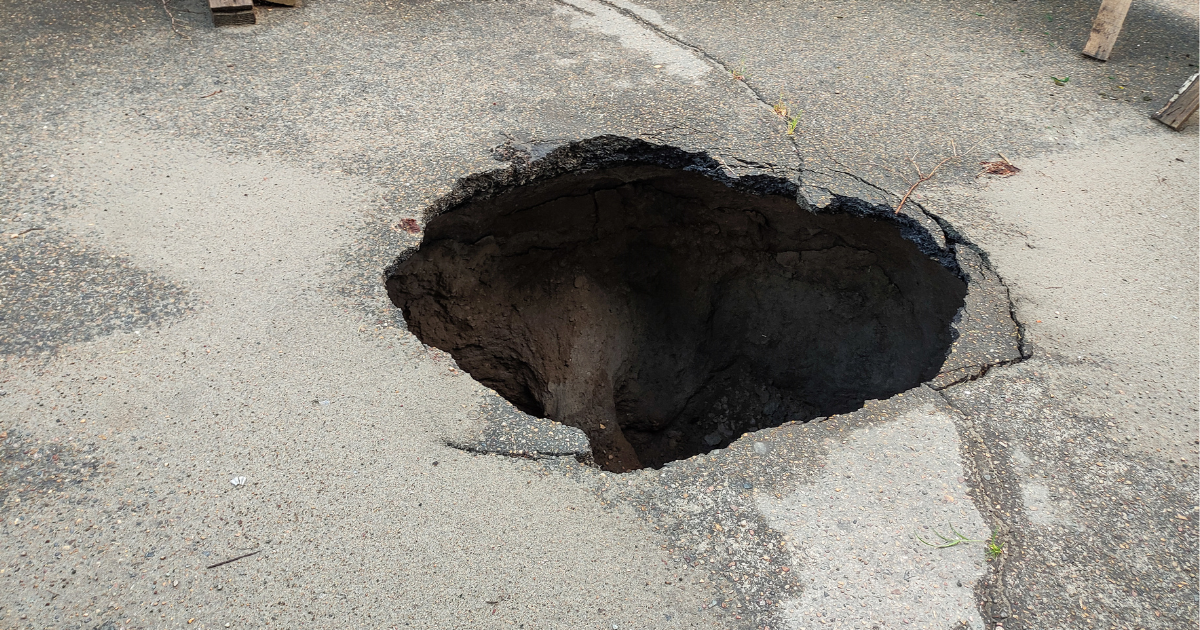
A cover-collapse sinkhole forms in the soil on top of the rock. Water widens cracks in the limestone, soil washes down into them, and a void grows under an arch of soil until the arch gives way (KGS, Cover-Collapse Sinkholes, January 2023).
Kentucky soil over limestone is typically less than 25 feet thick, so these sinkholes rarely exceed 20 feet across. KGS says they are unlikely to swallow a house. They can still "severely damage buildings," and a house over an old, filled sinkhole can suffer as the fill washes out.
Bedrock collapse and the Corvette Museum
A bedrock collapse happens when a cave roof gets too thin to hold the weight above it. KGS calls it "the least likely way a sinkhole can form." Bowling Green still has the famous example.
At 5:39 a.m. on February 12, 2014, a cave opened under the National Corvette Museum and eight Corvettes fell in. The hole was 40 feet wide and 30 feet deep (NPR, February 2016). City geologist Nick Lawhon called bedrock collapses like it rare (WBKO, March 2026).
Risk changes across town
Two houses a few miles apart can sit over very different ground. After more than ten inches of rain in four days in April 2025, Lawhon said areas north of the Barren River drain to caves about 150 feet down in many places. Around Russellville Road and Nashville Road, caves are "often 15-20 feet or sometimes less below the surface" (WKYU, April 2025).
The city responded to at least 18 new sinkholes by April 8, 2025 (WKYU, April 2025). By late May it was tracking a little over 30. The city commission approved nearly $1 million for repairs, almost ten times its usual yearly sinkhole funding (Spectrum News 1, May 2025).
Sinkhole Flooding and Bowling Green's Karst Rules
Sinkhole flooding happens when rain reaches a sinkhole faster than the caves below can carry it away. KGS writes that "Sinkhole flooding in Bowling Green (Warren County) is well known" and led the county to adopt strict rules (KGS, Sinkhole Flooding, January 2023).
It is easy to mislabel, since it usually happens in the same storms that flood rivers. KGS also notes that sinkholes flood more often when there is development in their watershed.
What the local rules cover
The Warren County Subdivision Regulations, amended September 18, 2025, set drainage standards in Section 6.4 (City-County Planning Commission of Warren County, read September 2026). Among them:
- Topographic surveys must show "sinkholes/surface depressions."
- Sinkholes and drywells in retention basins "shall be assumed to have no outflow" in drainage math.
- Finished floors next to retention and detention basins must sit 24 inches above the 3-hour, 100-year high-water mark.
The Focus 2030 Comprehensive Plan calls for keeping bans on building in "10-year frequency sinkhole flood zones." It also calls for an approved engineering plan to fill a sinkhole.
What they do not cover
Every rule above governs new development, and none retrofits a house already standing. KGS is direct: "Once a building has been erected, it is usually too late to make any cost-effective corrections."
Its listed choices are raising the house on pilings, tearing it down, or moving it. Engineering fixes are "frequently only partly successful" and "often cost more than the value of the property to be protected." That is hard news for an owner, and it is why pricing the condition in can beat chasing a fix.
Warning Signs a Bowling Green House May Be Affected
The common warning signs are a growing dip in the yard, cracks that return, doors that stop closing square, and water that ponds after heavy rain. KGS tells buyers in karst areas to check for exactly these, so a buyer's inspector likely will too.
KGS advises buyers to "check doorframes and windows for squareness." It also tells them to look for "shallow depressions and arch-shaped cracks in the soil" and to ask whether any sinkholes were filled.
| Warning sign | What it may mean | Who evaluates it |
|---|---|---|
| A new or deepening dip in the yard | Soil washing into an opening in the limestone | A geotechnical engineer or karst geologist |
| Arch-shaped or circular cracks in the soil | A soil arch starting to fail over a void (KGS) | A geologist; keep people and pets away |
| Foundation, brick, or drywall cracks that return | Settlement, possibly over a filled sinkhole | A structural engineer, often with a geotechnical report |
| Doors and windows that stick or sit out of square | Frame movement from uneven settlement | A home inspector first, then an engineer |
| Water that ponds after rain or rises for days | A closed depression draining slowly, or sinkhole flooding | A civil or geotechnical engineer |
| Basement or crawl-space water after big storms | Shallow groundwater or poor surface drainage | An engineer, then a drainage contractor |
| A sudden open hole | An active cover collapse | Fence it off and call Public Works at (270) 393-3628 |
Many of these signs have ordinary causes, like a clogged downspout or shrink-swell clay. KGS notes that shrinking-swelling soils and flooding cause more damage in Kentucky each year than earthquakes (KGS, Karst as Geologic Hazard, January 2023). An evaluation tells you which problem you have.
Kentucky Sinkhole Disclosure: What Form 402 Asks
Kentucky's seller disclosure form, KREC Form 402, asks about soil and drainage problems "whether or not they have been corrected," so a known sinkhole belongs on it. Section 5, Land/Drainage, asks about:
- 5(a)(1): soil stability
- 5(a)(2): drainage, flooding, or grading
- 5(a)(3): erosion
- 5(b): whether the house is in a Special Flood Hazard Area
- 5(c): any retention or detention basin, pond, creek, or spring on or next to the property
Section 3 asks about the foundation, floors, walls, doors, windows, basement leaks, and crawl-space water (KREC Form 402, revision 12/2022). The instructions say to "Report all known conditions affecting the property." The form is a statement of what you know and "shall not be a warranty."
When the form is required
The form satisfies KRS 324.360. That statute applies to single-family sales "if any person licensed under this chapter receives compensation" (KRS 324.360(1)). The listing agent delivers the form within 72 hours of receiving a written offer (KRS 324.360(4)).
A direct sale with no paid licensee falls outside the statute, but silence is still risky. A seller who hides a known defect can face a fraud claim. Have a Kentucky real estate attorney review your facts.
Gather engineer reports, repair invoices, photos, and dates for any sinkhole work or flooding. A clear history helps you answer Form 402 and gives a buyer facts to price instead of guesses.
Why Insurers and Financed Buyers Hesitate
Standard homeowners policies generally exclude earth movement, which usually includes sinkholes, and lenders want insurable, sound collateral. A known sinkhole can slow a financed sale or stop it midway.
How sinkhole coverage usually works
Most policies carry an earth movement exclusion, and sinkhole collapse typically falls inside it. Some carriers sell a separate sinkhole endorsement for an extra premium. Terms vary, and a known sinkhole or earlier claim can make one hard to get. Flood is a separate policy again, so read your exclusions and ask your agent.
Why lenders and appraisers pause
A lender makes the loan against the house, so it wants the house insurable and structurally sound. An appraiser typically notes visible conditions that affect soundness. A depression, settlement cracks, or basement water can turn into a request for an engineer's report or repairs before closing.
Any of those can reopen price talks or end the contract. Warren County listings spent a median 57 days on the market in August 2026 (Realtor.com via FRED, August 2026). A failed contract can mean starting over.
What Sinkhole Repairs Involve
Repair starts with a geotechnical evaluation, because the fix depends on where the void is, how deep the soil runs, and whether water is involved. KGS says to consult a geologist "experienced in identifying karst subsidence and an engineer experienced in sinkhole remediation."
Evaluation, grouting, and underpinning
An evaluation may include soil borings and other subsurface testing. If a sinkhole threatens a building, KGS says to shore up the foundation quickly and "transfer the load of the building to competent bedrock." Engineers may use piers to reach rock, or inject grout to fill voids and densify loose soil, a method called compaction grouting.
The hole can then be filled with a graded filter, layers of rock that let water drain while holding soil back. KGS still says "the safest strategy" is "not to fill a sinkhole" unless it is essential. Dumping dirt in can plug a drain and push water somewhere worse.
What repairs cost
No published Kentucky price list for private sinkhole repair could be verified, so get written estimates. For scale only, the city estimated $90,000 to $120,000 to repair one residential site with several sinkholes 5 to 10 feet wide (WBKO, March 2026). That was a public works job, not a quote for your house.
Should You Repair, List, or Sell Your Bowling Green House As-Is?
The right path depends on how serious the condition is, how much cash and time you have, and whether a repair would make the house easy to finance again.
- Repair, then list. This fits when an engineer defines the fix and you can fund it. You still disclose the history.
- List as-is with full disclosure. Some buyers accept a known condition. Expect inspection findings and lender conditions.
- Get a cash offer on the house as it stands. No lender approval, no lender's appraisal, and no repairs first.
The typical Bowling Green house was worth $281,762 in August 2026, up 0.2% in a year (Zillow ZHVI, August 2026). With flat values, a buyer has little appreciation to lean on when taking on repair risk.
If the condition is minor, the fix is defined, and you have time, listing with an agent may net you more. If a cash sale is not your best move, Propcash will say so and can point you to a local agent. We may receive compensation from agents we refer.
How a Cash Offer Can Price the House As It Stands
A direct cash offer can be priced on the house as it stands, with the ground condition and local sales data built into one number you can see explained. Propcash is a direct cash homebuyer, founded in 2026 and based in Nashville, that makes offers as a principal.
The inputs include what any engineer found, whether water gets in, which part of town the house sits in, and recent sales in the ZIP code. You do not need to repair, fill, clean, or stage anything first.
You still disclose what you know, and the offer prices it in. There are no fees or commissions charged to you. A closing attorney or title company handles closing, and cash closings can happen in as few as 7 days on a date you choose. The offer stands while you decide.
For many owners, the relief is no longer watching the yard after every storm. You can find out what your house could sell for as-is, read about Bowling Green cash offer options, or see how Propcash handles houses that need major repairs.
Why wait? Sell your house “as is” for cash today
Tell us about your house. We'll make you a cash offer based on local market data.
Let's chatFrequently Asked Questions
Do you have to disclose a filled or repaired sinkhole when selling a house in Kentucky?
If you complete KREC Form 402, yes. Section 5 asks about soil stability and drainage, flooding, or grading problems "whether or not they have been corrected." The form is required under KRS 324.360 when a real estate licensee is paid in a single-family sale. Without one, hiding a known defect can still invite a fraud claim, so ask a Kentucky attorney.
Does homeowners insurance cover sinkhole damage in Bowling Green?
Usually not under the base policy. Standard homeowners policies generally exclude earth movement, and sinkhole damage typically falls inside that exclusion. Some carriers sell a separate sinkhole endorsement, but terms vary and a known sinkhole can make one hard to add. Flood needs its own policy, so read yours and ask your agent.
Can you sell a Bowling Green house that floods from a sinkhole?
Yes, as long as the flooding is disclosed. Form 402 asks about drainage, flooding, or grading problems and about basement leaks, so a buyer will see the history early. The Kentucky Geological Survey says fixes for flooding sinkholes under existing buildings are often costly and only partly successful. Many owners price the condition in instead.
Who fixes a sinkhole in a Bowling Green yard?
It depends on where the sinkhole sits. After the April 2025 storms, the city geologist said the city would likely repair 11 of the first 18 reported sinkholes. The rest were on county, private, or commercial property (WKYU, April 2025). Report a new sinkhole to Bowling Green Public Works at (270) 393-3628, then call a geotechnical engineer.
Will a sinkhole stop a buyer from getting a mortgage in Bowling Green?
It can slow or stop one. A lender needs the house to be insurable and sound. An appraisal or inspection that notes a depression, settlement cracks, or basement water can lead to requests for an engineer's report or repairs before closing. Cash sales skip lender approval and the lender's appraisal.
Was the Corvette Museum sinkhole typical for Bowling Green?
No. The 2014 collapse at the National Corvette Museum, 40 feet wide and 30 feet deep, happened when a cave roof gave way. The Kentucky Geological Survey calls bedrock collapse rare, and the city geologist said the same in March 2026 (WBKO, March 2026). Most local sinkholes form in the soil above the rock.
Data Sources: Kentucky Geological Survey; USGS; U.S. Census Bureau; NPR; WKYU; Spectrum News 1; WBKO; Warren County Planning Commission; KREC Form 402; KRS 324.360; Realtor.com via FRED; Zillow. Propcash is a direct cash homebuyer, not a law firm, insurer, or engineer.