
Key Takeaways
- Tampa Bay sits in Florida's karst belt: the corridor running north through Pasco and Hernando counties is widely called "sinkhole alley," and the same limestone ground movement reaches into the city of Tampa itself.
- Florida law requires disclosure: the common-law duty from Johnson v. Davis makes you disclose known material defects, and Florida Statute 627.7073 requires telling a buyer whether a paid sinkhole claim was used to repair the damage.
- Selling as-is does not skip disclosure: an as-is sale changes who pays for repairs, not what you must tell the buyer about the sinkhole history.
- Insurance is split by statute: Florida requires catastrophic ground cover collapse coverage but treats broader sinkhole loss coverage as an optional add-on that many policies exclude (Fla. Stat. 627.706).
- Financing is the choke point: lenders rarely approve a loan on an unrepaired sinkhole house, which shrinks the buyer pool down to cash.
- A cash sale can close in as few as 7 days: Propcash buys sinkhole houses as-is, factors the repair scope into the offer, and shows you the local market data behind the number. A traditional Tampa listing took a median of 47 days to go under contract as of April 2026 (Redfin, April 2026).
If you need to sell a house with sinkhole damage in Tampa, you are working two problems at once. The first is the ground itself: cracked walls, doors that stick, a floor that no longer sits level, and a repair path that runs deep below the foundation. The second is the sale, because Florida law tells you exactly what you must disclose, and most mortgage lenders will not fund a purchase until the damage is fixed and the insurance question is settled.
A sinkhole house is a hard situation, not a shameful one. Plenty of solid Tampa homes carry karst geology under them through no fault of the owner. This guide covers what Florida sinkhole law defines and requires, why financing and insurance fall apart on these houses, what repair actually involves, how the selling paths compare, and how an as-is cash sale works in Tampa's 2026 market.
Why wait? Sell your house “as is” for cash today
Tell us about your house. We'll make you a cash offer based on local market data.
Let's chatWhy Sinkholes Threaten Tampa Bay Houses
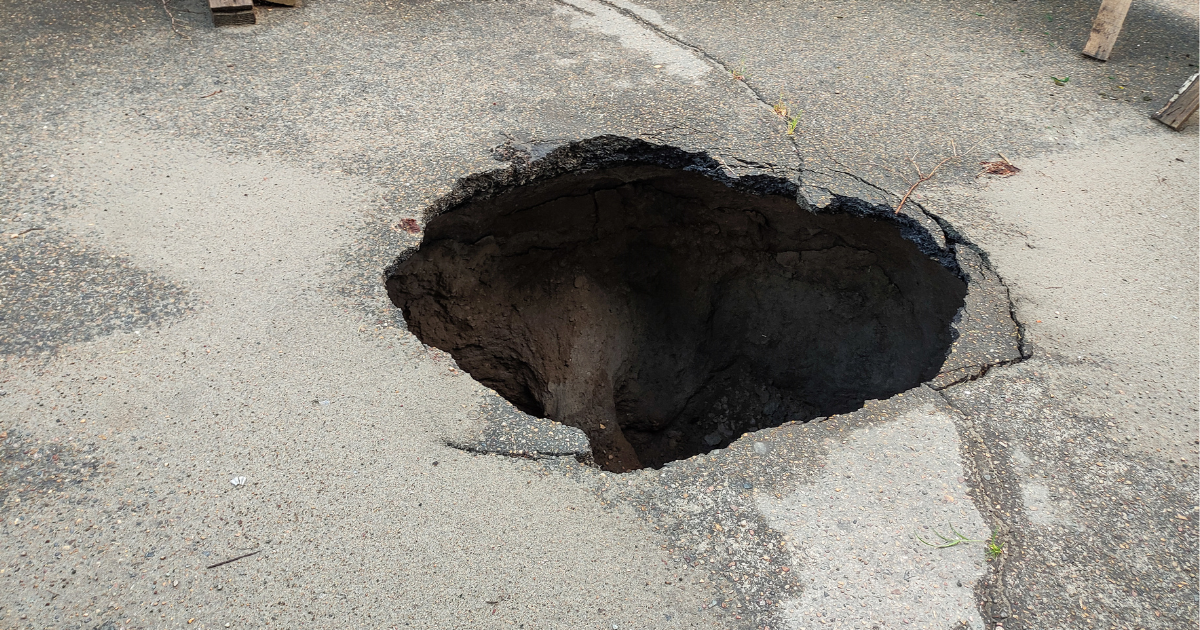
Tampa Bay sits on limestone karst, the geology that produces sinkholes, which is why sinkhole activity is a persistent fact of life across the region. Slightly acidic groundwater dissolves the soft limestone over long spans of time, leaving voids underground. When soil and sediment ravel down into those voids, the surface above can settle slowly or drop suddenly, and anything built on top moves with it.
Florida leads the nation in reported sinkhole activity, and the belt running north of Tampa through Pasco and Hernando counties is so active that geologists and insurers informally call it "sinkhole alley." That name reflects decades of documented ground movement, not marketing. The same karst formation underlies the city of Tampa, so the risk does not stop at the county line.
The Two Patterns Owners See
Most Tampa-area sinkholes fall into one of two patterns. Cover-subsidence sinkholes are the common, slow kind: sandy soil filters gradually into voids below, and the surface settles over months or years, showing up first as hairline drywall cracks, binding doors, and floors that pitch slightly. Cover-collapse sinkholes are the sudden, dramatic kind that reach the news, when a firmer clay layer bridging a void finally gives way abruptly.
For selling purposes, the pattern matters less than the record. Any known sinkhole activity triggers Florida disclosure duties and changes how buyers, lenders, and insurers treat the house.
What Florida Law Requires You to Disclose
Florida requires a home seller to disclose known sinkhole activity, because state law treats it as a material defect that a buyer cannot see for themselves. The controlling rule comes from the Florida Supreme Court in Johnson v. Davis, which held that a seller must disclose facts materially affecting the value of the property that are not readily observable and are unknown to the buyer. A history of sinkhole cracking, testing, or repair fits squarely inside that duty.
Florida statute adds a sinkhole-specific layer on top of the common-law duty. Under Fla. Stat. 627.7073, when a sinkhole claim has been paid on a property, the seller must disclose to the buyer, before closing, that a claim was paid and whether the full proceeds were used to repair the damage. That statutory disclosure travels with the house and cannot be undone by time.
Selling As-Is Does Not Exempt You
An as-is clause does not remove the disclosure duty, it only shifts who pays for repairs. As-is means the buyer accepts the house in its current condition and you are not funding the fix. It does not mean you can stay silent about sinkhole history you know about. If you know the ground moved, you disclose it, whether you sell to a neighbor, list with an agent, or sell to a cash buyer.
Shading the disclosure is not worth it. A buyer who later discovers concealed sinkhole history can pursue legal remedies under Florida law, which can include unwinding the sale or seeking damages. If you are unsure what your situation requires, talk with a Florida real estate attorney first.
Full disclosure tends to work in your favor with a cash buyer. A buyer that purchases sinkhole houses expects the geological reports and claim records up front, prices the condition in from the start, and closes with complete knowledge of the house, which leaves little to argue about after the sale.
How Sinkhole Insurance Works Under Florida Law
Florida insurance law splits sinkhole coverage into two very different pieces, and knowing which one you have decides whether a claim is even worth filing. Under Fla. Stat. 627.706, every residential property policy in Florida must include catastrophic ground cover collapse coverage, but the statute sets a high bar for what qualifies. Broader sinkhole loss coverage, which reaches ordinary sinkhole structural damage, is an optional add-on that many carriers exclude or price steeply.
| Coverage Type | What It Covers | Is It Standard? |
|---|---|---|
| Catastrophic ground cover collapse | Abrupt collapse of the ground, a depression visible to the naked eye, structural damage to the building, and the structure being condemned and ordered vacated | Required in every Florida property policy (Fla. Stat. 627.706) |
| Sinkhole loss coverage | Structural damage from sinkhole activity that falls short of a full catastrophic collapse, such as slow cover-subsidence cracking | Optional add-on for extra premium; many policies exclude it (Fla. Stat. 627.706) |
The gap between those two pieces is where owners get stuck. A slow cover-subsidence sinkhole can crack a foundation without ever meeting the catastrophic collapse test, so a policy carrying only the required coverage may pay nothing. Even when sinkhole loss coverage does apply, Florida law lets the insurer run its own testing before it pays (Fla. Stat. 627.707), and that process can stretch across months.
Once a sinkhole claim is paid, Florida law requires you to disclose it to future buyers (Fla. Stat. 627.7073), and it can affect how the next owner insures the property. Filing a claim you do not carry through to a completed, certified repair can make the house harder to sell without giving you a finished repair to show for it.
Why Financing Collapses for Sinkhole Houses
Financing is the single biggest reason sinkhole houses are hard to sell on the open market. Most buyers need a mortgage, and a mortgage lender wants clear title, an appraisal that supports the loan, and property insurance that protects the collateral. A sinkhole history strains all three at once.
Lenders routinely decline to finance a house with unrepaired sinkhole damage, and even a fully remediated house draws extra scrutiny. Many lenders will ask for an engineer's certification that the ground is stable, plus sinkhole coverage the buyer may not be able to obtain at a workable price. Each added condition trims the pool of buyers who can actually close, and in Florida's strained insurance market those conditions are harder to satisfy than they once were. For a broader look at how coverage costs are reshaping Florida sales, see our guide to Florida's insurance crisis and when selling makes more sense than staying.
The result is a narrow, self-selecting buyer pool. Cash buyers do not need lender approval or a lender's insurance condition, so a sinkhole house that stalls with financed buyers often trades cleanly for cash. That is why so many Tampa owners with sinkhole history end up selling to a direct cash buyer rather than waiting out failed loan approvals.
What Sinkhole Repairs Involve
Sinkhole repair means stabilizing the ground and, in serious cases, the foundation, which is why it is slower and deeper than most home repairs. Nearly every path starts with an engineering study: a licensed geologist or engineer uses ground-penetrating radar and soil borings to map the voids below and confirm what is happening. Only after that assessment can a contractor design the fix.
Two families of repair do most of the work. Grouting pumps material into the soil to fill voids and firm up loose ground, using either a compaction grout or a chemical resin depending on conditions. Underpinning drives steel piers down through the unstable soil to firmer bearing and transfers the building's load onto them, which is reserved for cases where the structure itself has moved. Severe cases combine both, followed by cosmetic repair of the cracked walls and floors above.
Two hard truths shape the decision. Even a complete, certified repair carries no promise that new voids will not form later, because the underlying karst geology does not change, and the sinkhole history stays on the property record under Florida disclosure law. For owners without insurance proceeds that cover the full scope, funding a deep repair out of pocket often makes less sense than selling the house as it stands.
Repair First or Sell As-Is: Comparing the Paths
A Tampa owner with a sinkhole-damaged house has four realistic paths, and the right one depends on your budget, your timeline, and how much of the repair burden you want to carry. Here is how they compare, with no repair-cost guesswork, since real numbers only come from an engineering study of your specific house.
| Path | Typical Timeline | Repairs Needed First | Main Constraint |
|---|---|---|---|
| Repair, then list | Many months: engineering and remediation, then a 47-day median market time (Redfin, April 2026) | Full remediation | Large upfront repair spend, and a stigma discount can remain after the fix |
| List as-is with an agent | Months, often longer than the citywide median | None | Small pool of buyers who can pay cash or qualify for a loan |
| File an insurance claim first | Often months to over a year on the insurer's schedule | Depends on the settlement | Coverage limits, testing disputes, and carrying costs while you wait |
| Direct cash sale | As few as 7 days after accepting an offer | None | Offer reflects the as-is condition and repair scope |
When Listing Still Makes Sense
Honesty matters here: if your house had a minor, fully remediated sinkhole with clean engineering documentation, and you have the time and money to present it well, listing with an agent may net you more than a cash sale. Propcash will tell you that plainly if it is true for your house. The cash path earns its place when the damage is unrepaired, the carrying costs are stacking up, or you simply want the house off your hands without funding a deep repair and chasing a shrinking buyer pool.
Where Sinkhole History Comes Up Around Tampa
Sinkhole risk around Tampa is not spread evenly, and knowing your pocket helps you set expectations for a sale. The historically most active ground runs north of the city through Pasco County towns such as Hudson, Holiday, and New Port Richey, and into Hernando County around Spring Hill, the heart of the informal sinkhole alley. Eastern Hillsborough County, including Seffner and Plant City, has also seen serious cover-collapse events, among them the widely reported 2013 Seffner collapse.
Within the city of Tampa, older neighborhoods built on karst ground tend to show the slow cover-subsidence signs first. Because Florida disclosure duties apply anywhere sinkhole activity is known, the questions come up in premium and modest pockets alike. Buyers in these areas ask early, so the disclosure documents do real work in the sale.
If your house sits in one of those pockets, our Tampa Bay sell-house-fast page covers how subsidence history, roof age, and flood zone are priced into a direct cash offer across Hillsborough, Pinellas, and Pasco.
What a Tampa House Is Worth in 2026
Tampa is a high-priced but flattening market in 2026, which affects every seller and weighs heaviest on houses with complications. The median sale price of a Tampa home was about $451,000 over the three months ending April 2026, up 1.3% year over year, and homes took a median of 47 days to go under contract (Redfin, April 2026). Read that against Zillow's separate measure of the typical Tampa home value, which covers the whole housing stock rather than recent closings and stood at about $392,669, down 0.1% over the prior year (Zillow, 2026). The two figures measure different things and should not be averaged, but both describe a market that has stalled rather than climbed. These are city-of-Tampa figures.
Price level is why the stakes are high on a clean sale. Tampa spans a wide range, from Old West Tampa near a typical value of about $316,949 to Davis Islands near $1,390,046 (Zillow, 2026), so meaningful equity is often in play even on a house that needs work. There is no honest way to attach a universal number to what a sinkhole house is worth: value depends on location, the scope of the ground movement, and what the house would be worth once stable, which is what an engineering study and a walkthrough are for.
How to Sell a House With Sinkhole Damage in Tampa for Cash
Selling a sinkhole house for cash means selling directly to a buyer that uses its own funds, buys the house as-is, and closes without a lender, which removes the financing and insurance conditions that sink traditional sales. Propcash is a direct cash homebuyer: we buy houses across America, including sinkhole houses in the Tampa area, and the process is built to be simple.
- Tell us about the house. Address, condition, and what you know about the sinkhole history, including any reports or paid claims. It takes about two minutes, and disclosure works the same way it would in any Florida sale.
- We evaluate it. We review the geological reports, the condition, the neighborhood, and local market data, and we factor the repair scope into our number instead of asking you to fix anything.
- You get a straight cash offer. We show you how we got to the number. No fees, no commissions, and no obligation to accept. You can get a cash offer and take it to your attorney or your family.
- You pick the closing date. Closings run through a licensed Florida title company and can happen in as few as 7 days, or on whatever timeline suits you.
Our offer stands while you decide. There is no countdown and no follow-up pressure, so you can take the time you need. And if a cash sale is not your best move, we will say so and point you to a local agent who fits.
The Bottom Line
Florida law lets you sell a sinkhole house, it just insists the buyer knows the history. The hard part is not legality but logistics: a deep repair you may not want to fund, insurance that splits into a required piece and an optional piece many owners never bought, and lenders that back away from unrepaired ground. If you would rather not spend months and a repair budget getting the house lender-ready, a direct as-is cash sale trades the top of the price range for speed and certainty. See current Tampa Bay cash home buyer options to compare what a direct sale could look like for your house.
Why wait? Sell your house “as is” for cash today
Tell us about your house. We'll make you a cash offer based on local market data.
Let's chatFrequently Asked Questions
Can I sell a house with sinkhole damage in Tampa?
Yes. Florida law does not stop you from selling a house with sinkhole damage or a sinkhole history, it only requires you to disclose what you know to the buyer. A financed sale is often the hard part, because most lenders will not approve a loan on an unrepaired sinkhole house and full sinkhole coverage can be costly or unavailable, which is why many Tampa owners sell as-is to a cash buyer instead.
Do I have to disclose sinkhole history when selling a house in Florida?
Yes. Under the Florida common-law duty set by Johnson v. Davis, a seller must disclose known defects that materially affect value and are not readily observable to the buyer, and sinkhole activity fits that standard. Florida Statute 627.7073 adds a specific duty: if a sinkhole claim was paid on the property, you must tell the buyer before closing whether the full proceeds were used to repair the damage. Selling as-is does not remove either obligation.
Do I have to repair a sinkhole before selling my Tampa house?
No. You can sell a sinkhole-damaged house in Tampa as-is, with no grouting, underpinning, or engineering repair completed first. A cash buyer reviews the geological reports and the condition during the walkthrough and factors the repair scope into its offer, while you stay responsible only for disclosing what you know about the sinkhole history.
Does homeowners insurance cover sinkhole damage in Florida?
It depends on your policy. Florida Statute 627.706 requires every property insurer to include catastrophic ground cover collapse coverage, but that applies only when the ground collapses abruptly, a depression is visible, the structure is damaged, and the building is condemned and ordered vacated. Broader sinkhole loss coverage is an optional add-on that many Florida policies exclude or price high, so a slow cover-subsidence sinkhole may not be covered at all.
Can a buyer get a mortgage on a house with sinkhole history?
Usually not without a struggle. Most lenders require full remediation with an engineer's certification, a clean report showing stability, and sinkhole coverage before they will finance a house with sinkhole history, and those conditions are often hard or expensive to meet. Because a cash buyer does not need lender approval, sinkhole houses in Tampa are commonly sold for cash.
How fast can I sell a sinkhole-damaged house in Tampa?
A cash sale can close in as few as 7 days once you accept an offer, because there is no loan approval, appraisal, or insurance condition to clear. A traditional Tampa listing took a median of 47 days to go under contract as of April 2026, before closing time is added, and a sinkhole house often sits far longer than the median because financed buyers struggle to close (Redfin, April 2026).
Data Sources: Redfin Tampa housing market data (April 2026), Zillow Home Value Index for Tampa and Tampa neighborhoods (2026), Florida Statutes 627.706, 627.707, and 627.7073 (sinkhole insurance, claim investigation, and sinkhole reports), and the Florida Supreme Court decision in Johnson v. Davis (seller disclosure duty). This article is general information, not legal, tax, or insurance advice. Propcash is a direct cash homebuyer, not a law firm or insurance advisor. Consult a licensed Florida real estate attorney about your disclosure obligations.