
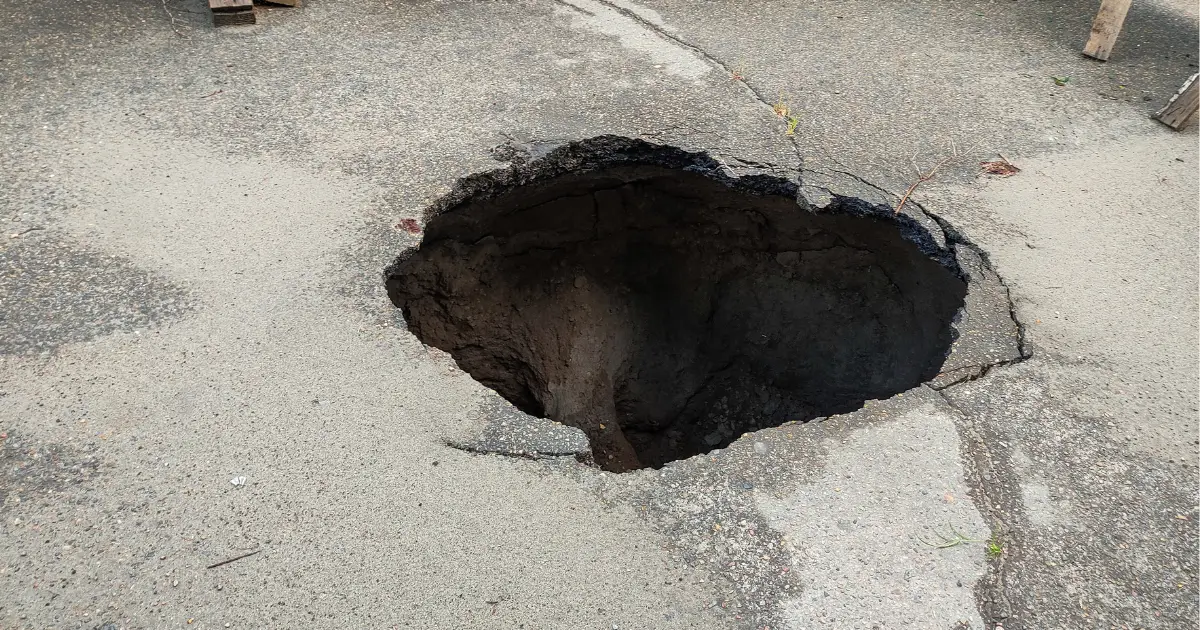
Tennessee law requires you to disclose a known sinkhole in writing before you sign a contract with a buyer.
The duty applies even when the plat map's contour lines do not show the sinkhole, and selling as-is does not remove it. A U.S. Geological Survey study done with the City of Murfreesboro tracked flooding in 78 local sinkholes after storms in 2001 and 2002.
This is general information, not legal advice. State rules vary.
Jump to a section
Do you already know where the sinkhole is on your lot?
Free. No obligation. You choose the closing date.
Selling a house with a sinkhole in Murfreesboro, Tennessee starts with one rule. Under Tenn. Code Ann. § 66-5-212(c), you must disclose a known sinkhole in writing before you sign a contract with a buyer. That holds even when the plat map's contour lines do not show it.
Sinkholes are part of the ground under this city. A U.S. Geological Survey sinkhole study done with the City of Murfreesboro mapped local sinkholes and tracked flooding in 78 of them after storms in 2001 and 2002. This guide covers what the law asks of you, what "known" means, what a buyer may find, and how your options compare.
What does Tennessee law require when you sell a house with a sinkhole?
Tennessee law requires you to disclose a known sinkhole on the property before you enter into a contract with a buyer. The disclosure goes in the contract or in a separate writing with an acknowledgment of receipt, and it is a separate rule from the general disclosure form.
Here is the core sentence of the statute, in its own words:
"... the seller shall, prior to entering into a contract with a buyer, disclose in the contract or in writing, including acknowledgment of receipt, the presence of a known sinkhole on the property."
Tenn. Code Ann. § 66-5-212(c)(1), Tennessee Code
The same subsection adds that the duty "applies regardless of whether the sinkhole is indicated through the contour lines on the property's recorded plat map." It also defines the term. A sinkhole is "a subterranean void created by the dissolution of limestone or dolostone strata resulting from groundwater erosion, causing a surface subsidence of soil, sediment, or rock" (Tenn. Code Ann. § 66-5-212(c)(2)).
The sinkhole rule works alongside the broader Residential Property Disclosure Act. The Tennessee Department of Health says that act "requires most sellers to provide a disclosure statement". That statement covers "Known defects or malfunctions of structures or systems" and conditions such as "flood or drainage issues." For the full statewide picture, see the Tennessee seller disclosure requirements guide.
The key sections line up like this:
| Statute | What it says, in short | Why it matters for a sinkhole |
|---|---|---|
| § 66-5-212(c) | Disclose a known sinkhole in the contract or in writing, before the contract | The specific sinkhole duty, plat map or not |
| § 66-5-202 | Give a disclosure statement, or a disclaimer only if the buyer waives the disclosure | The general form; the sinkhole rule is "in addition to" it |
| § 66-5-204 | No liability for an error not within the owner's actual knowledge, among other conditions | Ties the duty to what you actually know |
| § 66-5-208 | Buyer remedies: actual damages or ending the contract before closing; one-year window for damages | What is at stake if a disclosure is wrong |
Why sinkholes come up in Murfreesboro house sales
Sinkholes come up in Murfreesboro sales because the USGS study's three focus areas sit on limestone, and the city has a documented history of sinkholes that flood after heavy rain. That history is in a federal report.
The U.S. Geological Survey, "in cooperation with the City of Murfreesboro, Tennessee, conducted an investigation" from January 2001 through April 2002. The goal was "to delineate sinkholes and sinkhole watersheds" in the area. The report is Scientific Investigations Report 2005-5281, published May 2006.
Its findings are specific to this city.
- 78 sinkholes tracked: "Flooding in 78 sinkholes in three focus areas was identified and tracked using aerial photography" (USGS, May 2006).
- Three storms: the flooding followed major storms in February 2001, January 2002, and March 2002.
- Where: the three focus areas lie east, north, and northwest of Murfreesboro.
- The rock: those areas "are underlain primarily by the Ridley Limestone with some outcrops of the underlying Pierce Limestone."
None of this means a given house has a sinkhole. It does explain why buyers, inspectors, and attorneys in Rutherford County ask about them. If you know of one on your lot, the statute expects it in writing.

What counts as a known sinkhole?
The statute uses the word "known," and the related disclosure sections tie a seller's liability to actual knowledge. The text does not define every situation, so it helps to stick to what the statutes say.
Three pieces of the law shape the answer:
- The sinkhole section covers "the presence of a known sinkhole on the property." Under § 66-5-212(c)(1), the plat map's contour lines do not control it.
- No investigation duty for the form: for the general disclosure statement, § 66-5-202 says "The owner shall not be required to undertake or provide any independent investigation".
- Actual knowledge: § 66-5-204 shields an owner from an error that "was not within the actual knowledge of the owner," among other cases, if the owner "was not grossly negligent" in getting third-party information.
In practice, think about what you have seen and what you have been told. A depression an engineer called a sinkhole, a past repair, or a report in your files all point to knowledge. Courts decide close cases on their facts, so a Tennessee real estate attorney is the right person for a gray area.
Does selling as-is remove the Tennessee sinkhole disclosure?
No. Selling as-is changes who handles repairs, but nothing in the sinkhole statute exempts an as-is sale from disclosing a known sinkhole.
Tennessee does allow a disclaimer in place of the general disclosure form. Under § 66-5-202, the owner can sell the house "as is" by giving a disclaimer statement. The statute defines that as "with all defects which may exist, if any," and the option has a limit: "A disclaimer statement may only be permitted where the purchaser waives the required disclosure" (Tenn. Code Ann. § 66-5-202).
The sinkhole rule sits on top of that choice. Subsection (c)(1) opens with "In addition to any other disclosure required by this part," and then says the seller "shall" disclose a known sinkhole. An as-is price and a written sinkhole disclosure go together. The buyer's signed acknowledgment of receipt also gives you a record that the buyer was told.

What a buyer's inspection may find
A buyer's inspection may turn up the surface signs that state guidance tells buyers to look for, such as shallow depressions, arch-shaped cracks in the soil, and damage to nearby structures. A buyer who finds them will likely ask questions.
The Tennessee Emergency Management Agency (TEMA) tells people to "observe geologic conditions around the area of the property". It points to "shallow depressions and arch-shaped cracks in the soil" as signs. It also says to "check for damage to structures around or adjacent to the property."
The same page speaks directly to buyers. It tells them to "Do your research on the property" and to "ask questions of the seller" before buying. It also advises: "Avoid building or buying a built structure on a sinkhole that has been filled." Some buyers will follow that advice to the letter, and some will not. A clear written disclosure lets each buyer decide early.
A late surprise carries risk for you as the seller. Under § 66-5-208, a buyer may seek "actual damages suffered as a result of defects existing in the property" or "termination of the contract prior to closing" over a faulty disclosure statement. A damages action, for defects the buyer did not know of by closing or occupancy, must be filed "within one (1) year" from the date the buyer received the disclosure statement, or from closing or occupancy if one came first. Ending the contract is subject to § 66-5-204.
Your options for selling a house with a sinkhole in Murfreesboro
You have three main options: repair the sinkhole and then list, list the house as it stands with full disclosure, or sell as-is for cash with full disclosure. Each one keeps the written sinkhole disclosure in place.
| Option | Repairs | Disclosure | Inspection | Timing |
|---|---|---|---|---|
| Repair first, then list | You hire a geologist or engineer and pay for the work | Required for a known sinkhole; repair records can go with it | Buyer inspection; a financed buyer's lender adds its own review | The repair period, then the listing period |
| List as-is with disclosure | None required from you; buyers may ask for credits | Required for a known sinkhole | Buyer inspection, often with follow-up questions | The listing period, plus the buyer's financing steps |
| Cash sale as-is with disclosure | None required from you | Required for a known sinkhole | The buyer's own review; no lender appraisal | Can close in as few as 7 days; you pick the date |
Repair first
Repairing first can widen the pool of buyers, and a documented fix gives them something to read next to your disclosure. TEMA advises consulting "a professional geologist with experience in identifying karst topography" and "an engineer experienced in sinkhole remediation." The cost and length of the work depend on what those experts find.
List as-is with disclosure
Listing the house as it stands avoids the repair project. You still owe the written sinkhole disclosure, and buyers will price what they read.
Sell as-is for cash
A direct cash sale skips repairs, showings, and the buyer's loan approval. The disclosure duty does not change: the buyer still gets it in writing before the contract. Some sellers look at all three paths side by side before choosing. Our Murfreesboro cash sale page explains how a direct sale works locally.
Paperwork to gather before you sell
Gathering your records before you list or take an offer makes the disclosure easier to write and easier for a buyer to trust. A short file often does the job.
- Your written sinkhole disclosure, with a line for the buyer's acknowledgment of receipt.
- Any geologist or engineer report on the sinkhole or on cracks and settling.
- Repair invoices and dates, if anything was filled or stabilized.
- Your recorded plat, knowing that its contour lines do not settle the question.
- Notes on drainage or ponding after heavy rain, since the general form asks about flood or drainage issues.
If you inherited the house and know little about its history, the rules on actual knowledge still apply to what you learn. The Murfreesboro inherited house guide covers the probate side of that sale. For houses that need structural work, see how Propcash handles houses that need major repairs.
How can Propcash help with a Murfreesboro sinkhole sale?
Propcash is a direct cash homebuyer, and we can buy your house as-is, with no repairs, no cleaning, and no showings. We make one cash offer based on local market data and show you how we got to our number.
There are no agent commissions and no fees, and you pick your closing date, which can be in as few as 7 days. A cash offer is one more number to set beside repairing first or listing with disclosure. There is no obligation, and our offers do not expire. If a cash sale isn't your best move, we'll tell you and point you to a local agent who is. When you are ready, you can get a cash offer on your Murfreesboro house.
Frequently Asked Questions
Do I have to disclose a sinkhole that was filled or repaired?
Tenn. Code Ann. § 66-5-212(c) covers the presence of a known sinkhole on the property, and the statute text does not carve out a sinkhole that was filled or repaired. Some sellers disclose the sinkhole along with the repair records, which gives a buyer the full history in writing. A Tennessee real estate attorney can confirm how the rule applies to your house.
What if the sinkhole is not shown on my plat map?
The duty still applies. Tenn. Code Ann. § 66-5-212(c)(1) says the sinkhole disclosure applies regardless of whether the sinkhole is indicated through the contour lines on the property's recorded plat map. What matters is whether you know about the sinkhole, not whether a surveyor drew it.
Does a cash buyer still get the sinkhole disclosure?
Yes. The sinkhole statute speaks of the seller and a buyer and says nothing about how the buyer pays. A cash sale can remove the lender's appraisal and financing steps, but it does not remove the written disclosure of a known sinkhole before the contract.
How long does a buyer have to sue over a bad disclosure in Tennessee?
Under Tenn. Code Ann. § 66-5-208, a damages action must be commenced within one year from the date the purchaser received the disclosure statement, or from closing or occupancy if one of those came first. The same section lets a buyer seek actual damages for defects the buyer was not aware of by closing or occupancy, or end the contract before closing, subject to § 66-5-204. Other claims, such as fraud, can follow other rules.
Who studied sinkhole flooding in Murfreesboro?
The U.S. Geological Survey did, in cooperation with the City of Murfreesboro, from January 2001 through April 2002. Its report, Scientific Investigations Report 2005-5281, delineated sinkholes and sinkhole watersheds and tracked flooding in 78 sinkholes in three focus areas after storms in February 2001, January 2002, and March 2002.
Who should look at a suspected sinkhole before I sell?
The Tennessee Emergency Management Agency advises consulting a professional geologist with experience in identifying karst topography and an engineer experienced in sinkhole remediation. A written report from either can tell you what you are dealing with. It also gives you something concrete to hand a buyer with your disclosure.
Reviewed by the Propcash Editorial Team under our editorial standards. Published by Propcash, a direct cash buyer of houses. This guide is general information. Laws, fees, and market figures change, so check the current rules for your state.
