
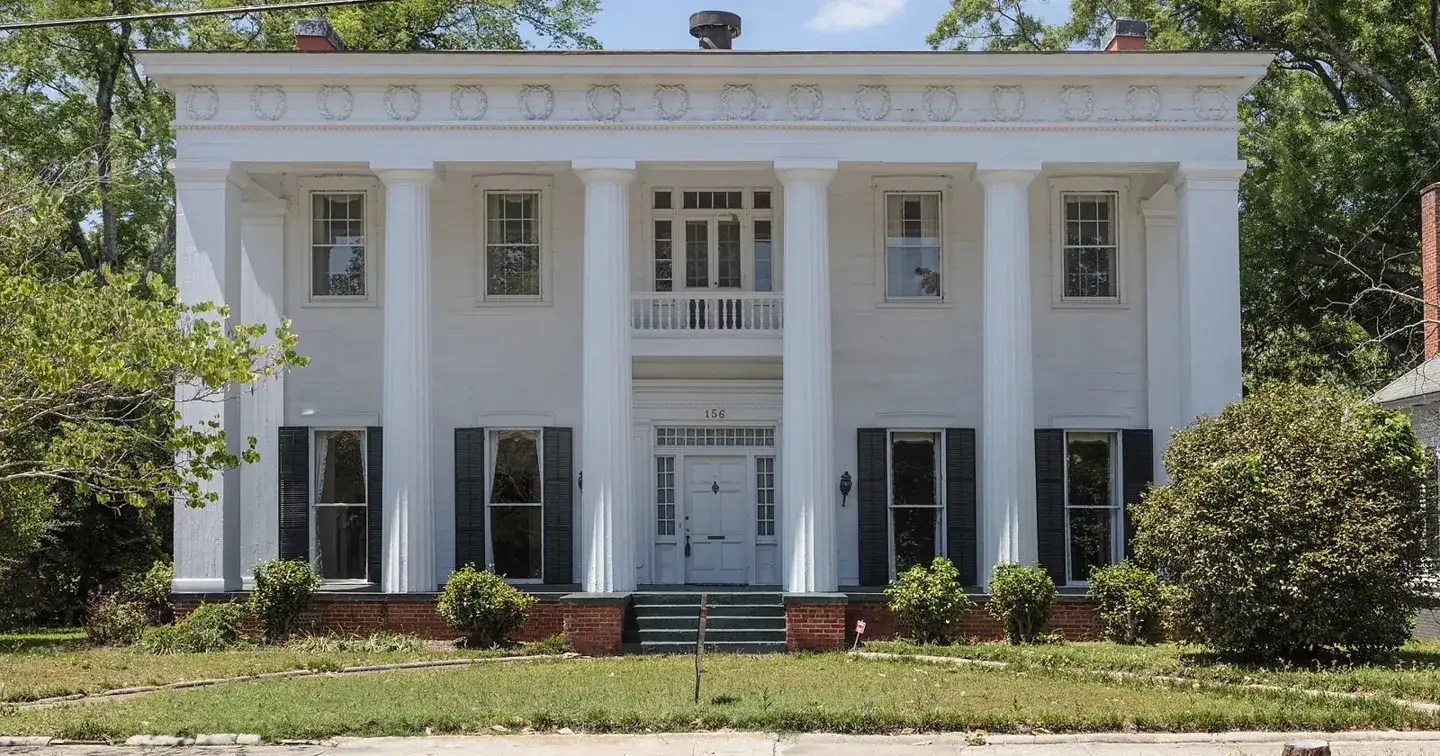
National Register listing alone adds no rules in Macon; only local design review districts review exterior work on a house.
Those districts are the Historic Commercial District, Central Business District, Cherokee Heights, Intown, Vineville, and Beall's Hill. The certificate of appropriateness covers exterior changes and demolition, not the sale, so an as-is buyer takes on future review.
This is general information, not legal advice. State rules vary.
Jump to a section
Is your Macon house inside a local design review district?
Free. No obligation. You choose the closing date.
Before you sell a historic house in Macon, find out which kind of historic it is. Macon-Bibb County is home to 17 National Register historic districts with more than 6,000 historic buildings (Historic Macon Foundation, November 2026). National Register listing by itself places no rules on a private owner. Only a local design review district, run by Macon-Bibb County Planning & Zoning, reviews changes to the outside of a house.
That split matters most to the owner or heir of a big period house in Vineville, Intown, Ingleside, or Shirley Hills. It decides whether a buyer inherits a review process and what you may need to disclose. It also shapes the choice between restoring, listing as-is, and selling as-is.
Does National Register listing limit what you can do with a Macon house?
No. Under federal law, National Register listing places no restrictions on a private owner unless the work involves federal money or a federal permit (National Park Service, November 2026).
"...the listing of a property in the National Register places no restrictions on what a non-federal owner may do with their property up to and including destruction..."
National Park Service, National Register of Historic Places FAQ
Historic Macon Foundation says the same about Macon on its National Register page. The Planning and Zoning Commission and the Design Review Board decide what changes are allowed "only within local historic districts." The page also notes that houses in a National Register district can be demolished, because the Register has no system to stop it.
Listing does bring one thing: eligibility for tax incentives, according to the same page. That can matter to some buyers, and the three paths below cover it briefly.
| Question | National Register only | Local design review district |
|---|---|---|
| What it is | A federal list of places worth preserving, kept by the National Park Service | A Macon-Bibb zoning district with its own design guidelines |
| Who reviews exterior changes | No historic review for private work without federal funding or permits | P&Z staff, the Design Review Board, and the P&Z Commission |
| New fence, roof, columns, or railings | No historic review; regular county permits may still apply | Design Review Board approval |
| Demolition | Not prevented by the listing | Needs a certificate of appropriateness |
| Interior work | No historic review | No certificate; a Zoning Work Release form before the building permit |
| What a buyer takes on | No historic review of future exterior work | The same review for every future visible exterior change |
| Macon examples | Ingleside, Shirley Hills, Pleasant Hill, North Highlands, Tindall Heights, Fort Hill, East Macon | Intown, Vineville, Cherokee Heights, Beall's Hill, Central Business District, Historic Commercial District |
The table draws on the National Park Service, Historic Macon Foundation, and Planning & Zoning pages cited in this guide. District boundaries can overlap, so a specific address is worth confirming with P&Z.
Which Macon design review districts require a certificate?
Six local districts carry design review: the Historic Commercial District, Central Business District, Cherokee Heights, Intown, Vineville, and Beall's Hill (Macon-Bibb County Planning & Zoning, November 2026).
P&Z picked these neighborhoods in the 1980s and wrote design guidelines for each district type. It then rezoned them to HR-1, HR-2, HR-3, HPD, CBD-1, CBD-2, and HC. Beall's Hill joined as a design district in 2005 under its own HBH zoning. The county's stated goal is work that keeps key historic features and fits the look of each district.
Several well-known National Register districts are not on that list. Ingleside, Shirley Hills, Pleasant Hill, North Highlands, and Tindall Heights appear on National Register roster, but not among P&Z's design districts. A big house in Ingleside may carry the historic name without the local review. A house on Vineville Avenue usually carries both.

How can you check whether your Macon address is under design review?
The P&Z map or a call to the office gives the answer. P&Z's district guide sends owners to the GIS/Public Maps on mbpz.org for this exact question.
- Find the parcel on the map. Historic Macon Foundation notes that most district maps sit under GIS Public Maps, then Zoning Maps, then Map Layers, then Historic Districts.
- Read the zoning code. A code of HR-1, HR-2, HR-3, HPD, CBD-1, CBD-2, HC, or HBH points to a design district.
- Try the online lookup. P&Z's design page invites owners to find out through Clariti, its online permit system.
- A call can confirm it. Planning & Zoning answers at (478) 241-2554, at 3661 Eisenhower Parkway, Suite MB104.
A printed map page or an email from P&Z gives a buyer and the closing attorney something concrete. It can save a round of questions later in the sale.
What work needs a certificate of appropriateness in Macon?
In a Macon design review district, nearly all exterior work needs a certificate of appropriateness, except routine maintenance and repair. Interior work does not need one, though it may need a building permit (P&Z guide).
The certificate is the county's permission to go ahead with exterior alterations, additions, or demolition. It usually has to be in hand before a building permit is issued. Staff can issue some certificates, while others need a public hearing before the Design Review Board.
| Project | Certificate? | Who decides |
|---|---|---|
| Repainting wood or masonry that is already painted | No (routine maintenance) | None |
| Re-nailing loose wood, epoxy and Dutchman wood repairs, reglazing or caulking windows | No (routine maintenance) | None |
| In-kind gutters, downspouts, locks, and hardware; replacing existing mechanical equipment | No (routine maintenance) | None |
| Masonry repairs, or replacing a whole window or door | Maybe | Staff decide whether one is needed |
| Painting a surface that was never painted, or stripping paint | Yes | Certificate required |
| Removing a dead or dying tree | Yes, with an arborist's statement | Often staff level for small dead or diseased trees |
| Replacing windows that do not meet the guidelines with an appropriate material and design | Yes | Staff level |
| Replacing windows that do not meet the guidelines with the same style and material | Yes | Design Review Board |
| New roofing, solar panels, a new or changed fence, handrail, or porch railing | Yes | Design Review Board |
| Changing column style, or replacing columns with resin or fiberglass | Yes | Design Review Board |
The table follows P&Z's guide for owners in design review districts. Detailed rules sit in the design guidelines.
Two lines in the guide that matter to sellers
The guide tells owners never to assume a neighbor's change is allowed. It may be grandfathered, or it may have been done without a permit. The guide also asks owners to document routine maintenance with before and after photographs. For a seller, those photos and any past certificates are worth keeping in the sale file.

How does design review work at Macon-Bibb Planning & Zoning?
P&Z staff review every certificate application and decide whether the change is visible from the public right of way. If it is, the application goes to the Design Review Board, then to the Planning & Zoning Commission a week later (Historic Macon Foundation, November 2026).
- Staff review. Staff check the application against the design guidelines and decide whether the change is visible from the public right of way.
- Design Review Board. Visible changes go to a public meeting on Mondays at 4 p.m. The applicant explains the plan, and the board gives feedback and a recommendation based on findings of fact.
- Planning & Zoning Commission. The item carries over to the commission hearing the following Monday at 1:30 p.m. The commission may add conditions, approve, or deny.
Recent board meetings were held in the MBPZ Conference Room at the Macon Mall, 3661 Eisenhower Parkway (Macon-Bibb County Planning & Zoning, November 2026). Most fall on Mondays, though one September 2026 meeting moved to a Tuesday. No outcome is certain, since each decision turns on the guidelines and the facts of the application.
What should you disclose when you sell a historic house in Macon?
Most Macon period houses were built long before 1978, so the federal lead-based paint rule usually applies. Before the buyer signs, the seller discloses known lead-based paint and hazards, shares available records and reports, and provides the EPA pamphlet (U.S. EPA, November 2026).
The rule also gives buyers a 10-day window for a lead inspection, which a buyer may waive. Sellers keep a signed copy of the disclosures for three years. Foreclosure sales are exempt, but as-is sales and cash sales are not on EPA's exemption list.
Georgia's law on stigmatized houses (O.C.G.A. § 44-1-16) shields an owner who does not volunteer certain facts, such as a death in the house. It still requires a truthful answer, to the best of the owner's knowledge, to a direct question. FindLaw's copy is current as of March 2024, so a Georgia attorney can confirm the latest text.
Historic-district paperwork worth gathering
- Whether the house sits in a local design review district, in writing from P&Z
- Copies of any certificates of appropriateness issued for past work
- Any open application, or any notice from Code Enforcement
- Lead paint reports, if any exist
A Georgia real estate attorney can say what your contract should include. Heirs selling a parent's house can find the probate steps in our guide to selling an inherited house in Macon.
Restore, list as-is, or sell as-is: which path fits a Macon period house?
The right path depends on your time, your budget, and how much exterior work the house needs. In a design review district, every visible exterior change adds a review step, so the path also decides who carries that review.
| Path | What you do | Design review | Who carries future exterior work |
|---|---|---|---|
| Restore, then list | Hire the work, prepare, show the house | You apply for any certificates before work starts | You, until closing |
| List as-is with an agent | Disclose, show the house, negotiate repairs | None for you unless you agree to make changes | The buyer |
| Sell as-is to a cash buyer | Disclose, pick a closing date | None for you | The buyer |
Restore, then list
Restoring puts the review in your hands. Visible work such as a new roof or porch railing goes to staff, then to the Design Review Board and the Planning & Zoning Commission a week apart. This path can suit an owner with time, a budget, and a contractor who knows the guidelines.
Tax incentives come up here, but they are narrow. The National Park Service says the federal 20% credit applies only to income-producing buildings, and owner-occupied houses do not qualify. Historic Macon Foundation describes Georgia programs for rehabilitated historic houses that require photographs taken before any work. A tax professional can say whether any of this applies to you or a buyer.
List as-is with an agent
Listing as-is skips the work and passes design review to the buyer. A buyer who plans a new roof, fence, or solar panels takes on the certificate process after closing. For context, Macon's typical value was about $171,500 in September 2026 (Zillow ZHVI, September 2026). In ZIP 31204, the figure was about $120,900. Those are area figures, not the value of any one house. Our Macon housing market guide has more local figures.
Sell as-is for cash
A direct cash sale hands the house over as it stands, with no showings and no repairs. The buyer carries any future exterior work and the review that comes with it. If the house sits empty while you decide, note that Macon-Bibb's blight tax process applies only to vacant houses. Our guide to selling a vacant Macon house before the blight tax explains how it works.
How can Propcash help you sell a period house in Macon?
Propcash is a direct cash homebuyer, and we buy Macon houses as-is, including houses inside design review districts.
You make no repairs and file no certificate applications to sell to us. Take what you want, leave the rest, and pick your closing date. Cash sales can close in as few as 7 days after the contract is signed, and Propcash is free for sellers.
We'll make you one cash offer based on local market data and show you how we got to our number. You can compare it with restoring or listing, and show it to your attorney, because our offer stands. If a cash sale is not your best move, we will tell you. See how it works on our Macon cash home buyer page, or request your cash offer when you are ready.
Frequently Asked Questions
Do I need design review approval just to sell a house in Vineville or Intown?
No approval for the sale itself appears in the county's design review guide. Macon-Bibb County Planning & Zoning ties a certificate of appropriateness to work on the house, such as exterior changes, additions, and demolition. A change of owner is not on that list. The new owner simply takes on the same review for any future exterior work.
Are Ingleside and Shirley Hills under local design review?
Both appear on Historic Macon Foundation's list of National Register districts, but neither appears on Planning & Zoning's list of local design review districts. That list names the Historic Commercial District, Central Business District, Cherokee Heights, Intown, Vineville, and Beall's Hill. Boundaries can overlap at the edges, so it can help to confirm a specific address on the P&Z map or by calling (478) 241-2554.
Can a buyer tear down a historic house in Macon?
Inside a local design review district, demolition needs a certificate of appropriateness, and no one can say in advance how the county will rule. Outside those districts, National Register listing does not stop demolition, according to Historic Macon Foundation. Regular county permits still apply either way.
Will the buyer of my Macon house qualify for a historic tax credit?
That depends on the buyer and the plan, so it is a question for the buyer's tax professional. The National Park Service says the federal 20% credit applies only to buildings in income-producing use, and owner-occupied houses do not qualify. Historic Macon Foundation describes separate Georgia programs for rehabilitated historic houses, which require photographs taken before any work begins.
Does the lead paint disclosure apply if I sell my old house as-is for cash?
Yes, for most houses built before 1978. EPA's list of exemptions includes foreclosure sales but not as-is or cash sales, so the seller still discloses known lead-based paint, shares available reports, and provides the lead pamphlet. A buyer may waive the 10-day inspection window, but the disclosure itself still applies.
Who answers design review questions in Macon-Bibb County?
Macon-Bibb County Planning & Zoning handles design review, and its office is at 3661 Eisenhower Parkway, Suite MB104, Macon, GA 31206. The phone number is (478) 241-2554. P&Z's design page also links its design guidelines and an online lookup for design review districts.
Propcash is a direct cash homebuyer, not a law firm or a tax adviser. Design review rules, disclosure duties, and tax programs apply differently to each house. A Georgia real estate attorney or a tax professional can advise on your situation.
Reviewed by the Propcash Editorial Team under our editorial standards. Published by Propcash, a direct cash buyer of houses. This guide is general information. Laws, fees, and market figures change, so check the current rules for your state.