
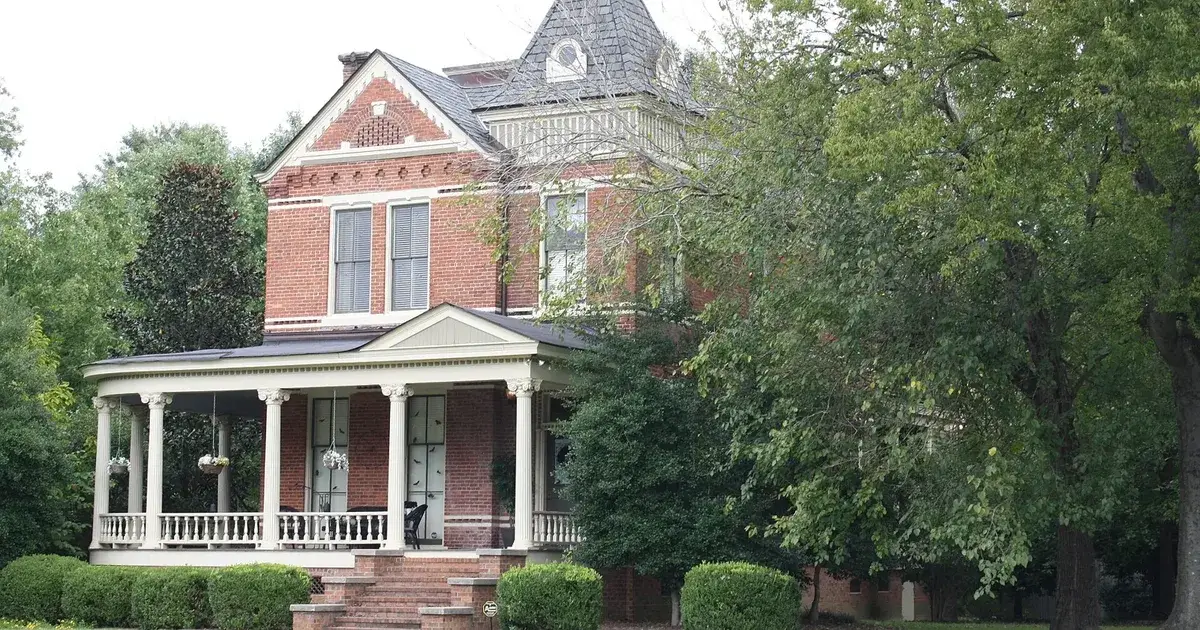
Columbus's historic rules require review for exterior work, such as a new roof or windows, not for the sale itself.
Under UDO 9.3.16, an owner who gets a neglect notice has 90 days to fix what it lists. In an as-is sale, the exterior work you leave undone passes to the buyer.
This is general information, not legal advice. State rules vary.
Jump to a section
Does your house need a roof, windows, or other exterior work?
Free. No obligation. You choose the closing date.
Selling a house in a historic district in Columbus, Georgia starts with one plain fact: the City reviews exterior changes, not sales. Ten neighborhoods hold local historic district status. The Board of Historic and Architectural Review (BHAR) decides what can change on the outside of the houses there.
That review shapes what a buyer can do after closing. It also shapes what an owner has to keep up before then. This guide covers the districts, the work that needs a certificate, the neglect rule, and what an as-is sale means here, using the City's own pages, the Unified Development Ordinance (UDO), and the BHAR Design Guidelines.
Do you need BHAR approval to sell a historic Columbus house?
A sale on its own needs no BHAR approval under the City rules read for this guide, because the review attaches to exterior work. The Board's page puts the rule in one sentence.
"A Certificate of Appropriateness is required for any change in materials or appearance to the exterior of a designated historic property prior to beginning construction."
Board of Historic and Architectural Review, Planning Department page, Columbus Consolidated Government
The ordinance spells out the reach. UDO 9.3.8 says "a material change in appearance shall not be made without a certificate of appropriateness." Its list of covered work includes new roofing materials, new exterior siding, and an exterior window or window frame.
A second rule runs for as long as you own the house. Under UDO 9.3.16, owners "shall not allow their buildings to deteriorate by failing to provide ordinary maintenance or repair." After a notice, "The owner of such property shall have 90 days to remedy all instances of deterioration or neglect."
Those two rules are why a historic address matters in a sale. A buyer who plans a new roof or new windows prices in the review. An owner who cannot keep up with repairs can receive a neglect notice before the house ever sells.
Which Columbus neighborhoods are historic districts?
Columbus has ten local historic districts, and the Design Guidelines name an eleventh, the Columbus Historic Riverfront Industrial District, a National Historic Landmark. The Planning Department says the ten neighborhoods are subject to the design guidelines the BHAR approved.
- Columbus Historic District
- Dinglewood
- High Uptown
- Liberty Heritage
- Peacock Woods-Dimon Circle
- Waverly Terrace
- Weracoba-St. Elmo
- Wildwood Circle-Hillcrest
- Wynn's Hill-Overlook
- Wynnton Village
The Design Guidelines also count 130 more resources designated as Landmark properties, which fall under the same review. A separate body, the Uptown Facade Board, reviews facades in the Central Riverfront District and the Uptown District under UDO 9.2.5.
Columbus Historic District
About twenty blocks of the original city grid sit on level floodplain beside the Chattahoochee. Building came in waves in the 1840s, the 1850s, and from 1880 to the 1910s. Vernacular shotgun houses cluster on the east side, and the largest houses line Broadway.
Liberty Heritage
Freedmen settled this area in the 1830s and 1840s, and the guidelines credit local African American builders and craftsmen with much of its architecture. The Liberty Theatre (c. 1924) and the house of Gertrude "Ma" Rainey stand here. It became a local district in 1969.
Waverly Terrace
G. Gunby Jordan filed the plat for the city's first planned subdivision on October 16, 1906. The 45 acres off Hamilton Road grew into a streetcar suburb over about 25 years. Craftsman is the dominant style.
Weracoba-St. Elmo
The guidelines call it the largest and most intact group of 1920s and 1930s middle-class housing in Columbus. Craftsman bungalows sit beside American Small Houses built after 1941. The district wraps the west side of Weracoba Park.
Wynnton Village
About 135 acres grew from antebellum estates along the old streetcar line on Wynnton Road. The 1843 Wynnton Academy and The Cedars (c. 1836) are listed on the National Register. Houses here were built mainly between 1920 and 1950.

How can you check whether a house is in a district?
The City's historic districts map, linked from the Planning Department's preservation page, is the first place to check an address. The Design Guidelines add that district lines sit on the Official Zoning Map, and they suggest asking the Planning Department for the current map, since zoning maps change.
The BHAR application makes this its first step. It asks the owner to confirm that the house sits in a local district or is a Landmark property, and that the planned work needs review. It also suggests booking time with a planner at 706-225-4421 at least two weeks before an application deadline.
For a seller, the answer matters even if no work is planned. It tells you whether a buyer's plans will need review, and whether the upkeep rule in UDO 9.3.16 applies to your house.
Which repairs need a Columbus GA certificate of appropriateness?
Under UDO 9.3.8, a certificate is needed before any exterior installation or removal that changes appearance, from roofing and siding to windows, doors, porches, and fences. Ordinary maintenance and interior work fall outside it. The table follows the ordinance's own list, which it calls "common, but not all inclusive."
| Work on the exterior | Certificate needed? (UDO 9.3.8) | What it means for a sale |
|---|---|---|
| New roofing, or removing the existing roofing | Yes, item B.8 | A buyer who plans a new roof adds the review to the project timeline. |
| New exterior siding, or removing existing siding | Yes, item B.10 | Covering or replacing original siding starts with an application. |
| An exterior window, window frame, or shutters, or filling in a window opening | Yes, item B.13 | Replacement window plans go to review before any work starts. |
| An exterior door or door frame, or filling in a door opening | Yes, item B.3 | A new front door is a reviewed change, not routine upkeep. |
| Screen or storm windows and doors | Yes, item B.12 | The Design Guidelines list these for staff review rather than a full Board hearing. |
| Decks, patios, driveways, and walks | Yes, item B.1 | Outdoor projects a buyer has in mind need approval too. |
| Enclosing a porch, or adding or removing an exterior wall | Yes, item B.4 | Turning a porch into a room is a reviewed change. |
| Fences and garden walls | Yes, item B.5 | A new fence for a dog or a privacy screen goes through review. |
| Ramps, exterior stairs, and fire escapes | Yes, item B.6 | An accessibility ramp also needs a certificate. |
| Sandblasting or other abrasive cleaning | Yes, section E | Cleaning brick this way is treated as a change, not maintenance. |
| Demolition or relocation of a building | Yes, section D (the Board has 90 days) | Plans to clear or move a building face the longest review. |
| A new building or parking lot | Yes, section C | Building on a district lot starts with the Board. |
| Paint and ordinary repair that keeps the existing form | No, section G | Upkeep before you sell needs no certificate. |
| Interior changes with no effect on the exterior | Not considered, section F | Kitchens, baths, and floors sit outside BHAR review. |
The line between upkeep and change matters. UDO 9.3.8(G) exempts ordinary maintenance or repair, paint included, that corrects decay or keeps the existing form without changing design, material, or outer appearance. The Design Guidelines add that minor in-kind repairs may be cleared by staff, and that painting a surface that was never painted needs staff review.
Building permits wait on the certificate. Under UDO 9.3.12, if the Board rejects an application for work that needs a building permit, "the building permit shall not be issued." If the list above reads like your house's repair list, our guide to selling a house that needs major repairs covers the wider choices.
How does BHAR review work in Columbus?
BHAR review in Columbus runs on a monthly cycle. You file in person by the posted deadline, appear at the Board meeting or send a representative, and get a decision within 45 days of a complete application.
What the application asks for
The application must carry the property owner's signature, and every fee is paid when it is filed. The City lists a $20 fee for staff review and a $50 fee for Board review. Supporting papers depend on the job:
- Elevation drawings and a site plan for remodeling or additions
- Paper photographs of each affected side of the house
- Details on doors and windows, where manufacturer data sheets may be used
- A written description and data sheets when new or non-historic materials are proposed
The BHAR application says an incomplete application is returned within seven days of receipt.
The meeting
The Board meets at 3:30 p.m. in Council Chambers at 3111 Citizens Way. The BHAR page is direct about attendance: "The case will not be heard without a representative present." An approved certificate can be picked up from the Planning Department on the Monday after the meeting.
The review clocks
Each step has a time limit set by the City's page or the UDO preservation article. An approved certificate must also be posted on the job site until the work is done and approved (UDO 9.3.11).
| Step | Time limit | Source |
|---|---|---|
| Application deadline | Before 5:00 p.m. on the posted deadline, about three weeks before each meeting (November 23, 2026 for the December 14, 2026 meeting) | BHAR page |
| Board decision | 45 days after proper documentation is filed and the Board's secretary signs the application; no action in that time counts as approval | UDO 9.3.10 |
| Demolition request | 90 days for the Board to approve or reject | UDO 9.3.8(D) |
| Appeal | 15 days to the Board of Zoning Appeals | UDO 9.3.15 |
| Certificate life | Void unless construction starts within six months | UDO 9.3.14 |
| Neglect notice | 90 days to remedy the listed problems | UDO 9.3.16 |
What happens if a historic house falls behind on upkeep?
If the BHAR finds a failure to provide ordinary maintenance or repair, it asks the Inspections and Code Division to notify the owner. The owner then has 90 days to fix what the notice lists (UDO 9.3.16).
The ordinance names the conditions it looks for. Broken windows, doors, and openings that let in weather and vermin count as neglect. So does a deteriorating structural system. The Board watches district buildings together with the Planning Division and the Inspections and Code Division.
Enforcement follows Chapter 12 of the UDO. The Design Guidelines call this "demolition by neglect," and they list avoiding it among their aims.
A neglect notice can reach an owner who is already stretched, such as an heir in another state or a landlord between tenants. If the house came to you through an estate, our guide to selling an inherited house in Columbus covers the probate side. A house that has reached a placard or a condemnation order is a separate code process, covered in our guide to selling a vacant or condemned house in Columbus.
How an open notice is handled in a contract, and what you need to disclose, are questions for a Georgia attorney. Georgia closings are typically handled by attorneys, so the closing attorney is one place to ask.
What does selling as-is mean in a Columbus historic district?
Selling as-is in a Columbus historic district means the exterior work you leave undone becomes the buyer's to plan, apply for, and pay for. The certificate rule follows whoever makes the change.
UDO 9.3.8 applies the requirement to "the owner or occupant" of a historic property or of any building in a district. After closing, that owner is the buyer. The duty stays with the house and moves to the next owner. As-is means as-is: the roof, the original windows, and the porch stay as they are.
Three practical points follow from the City's own documents:
- Before closing, you sign. A buyer who wants approval early needs your signature or your letter authorizing the work, because the application requires the owner's signature.
- A certificate has a shelf life. It runs with the building permit and becomes void if construction does not start within six months (UDO 9.3.14).
- A neglect clock keeps running. If a 90-day notice is open during a sale, who handles the repairs is a contract question for your attorney.
Price context helps when you weigh repairs against a sale. The Zillow Home Value Index for the city of Columbus was $175,906 in September 2026, up 3.1% from a year earlier. Our Columbus, Georgia housing market report covers the wider numbers.
Lead paint disclosure for pre-1978 houses
Houses built before 1978 carry a separate federal duty. The EPA's disclosure rule requires sellers to give buyers a lead hazard pamphlet, disclose known lead-based paint and hazards, and share available reports. Buyers get a 10-day window for a lead inspection, which they may waive, and sellers keep signed disclosures for three years.
How can Propcash help with a historic Columbus house?
Propcash is a direct cash homebuyer, and we can make a cash offer on a historic district house as it stands, roof, windows, and porch included. Our offer is based on local market data, and we show you how we got to our number.
There are no fees or commissions, you pick the closing date, and closing can take as few as 7 days after the contract is signed. A cash offer is one option to set beside listing, repairing first, or keeping the house. If the house shows well and you have time, a listing may net more, and if a cash sale is not your best move, we will tell you. You can see how it works on our Columbus, Georgia cash home buyer page, or request a no-obligation cash offer and compare it with your other options.
Frequently Asked Questions
Does a buyer need the owner's signature to apply for a certificate before closing?
A buyer who wants BHAR approval before closing needs the current owner's signature, because the City's BHAR application says the property owner must always sign it. If the applicant is not the owner on the deed, the application must include a letter from the owner authorizing the work. Until the sale closes, that owner is the seller.
Can you paint a historic Columbus house before listing it without a certificate?
Painting a historic Columbus house as ordinary maintenance needs no certificate under UDO 9.3.8(G), which exempts paint and repairs that keep the existing form. The Design Guidelines also say they do not regulate paint color. Painting a surface that was never painted before, or stripping paint, is listed in the guidelines for staff review.
Do BHAR rules cover the inside of a historic Columbus house?
BHAR review in Columbus does not reach interiors. UDO 9.3.8(F) says the Board shall not consider an interior arrangement or a use that has no effect on exterior features, and the Design Guidelines say they do not regulate interiors. Kitchens, baths, floors, and wiring fall under ordinary building permits, not the historic review.
How long does the BHAR have to decide on an application?
The Board of Historic and Architectural Review has 45 days to approve or reject a certificate application under UDO 9.3.10, and failing to act in that time counts as approval. The 45 days start only after proper documentation is in and the Board's secretary has signed the application. A demolition request has a separate 90-day window under UDO 9.3.8(D).
Is the Liberty Heritage district on the National Register of Historic Places?
Liberty Heritage is the one Columbus district the Design Guidelines name as not listed on the National Register, though three buildings inside it are listed. It is still a local historic district, designated in 1969, so BHAR review of exterior work applies there as in the other nine. The guidelines note that National Register listing alone does not protect a building from exterior changes.
Can a historic district house in Columbus sell with an open neglect notice?
A historic district house in Columbus with an open neglect notice can still be offered for sale, and Propcash can make a cash offer on it as-is. The notice gives the owner 90 days to fix the listed problems under UDO 9.3.16. How the notice is handled in the contract and in your disclosures is a question for a Georgia attorney.
Reviewed by the Propcash Editorial Team under our editorial standards. Published by Propcash, a direct cash buyer of houses. This guide is general information. Laws, fees, and market figures change, so check the current rules for your state.
