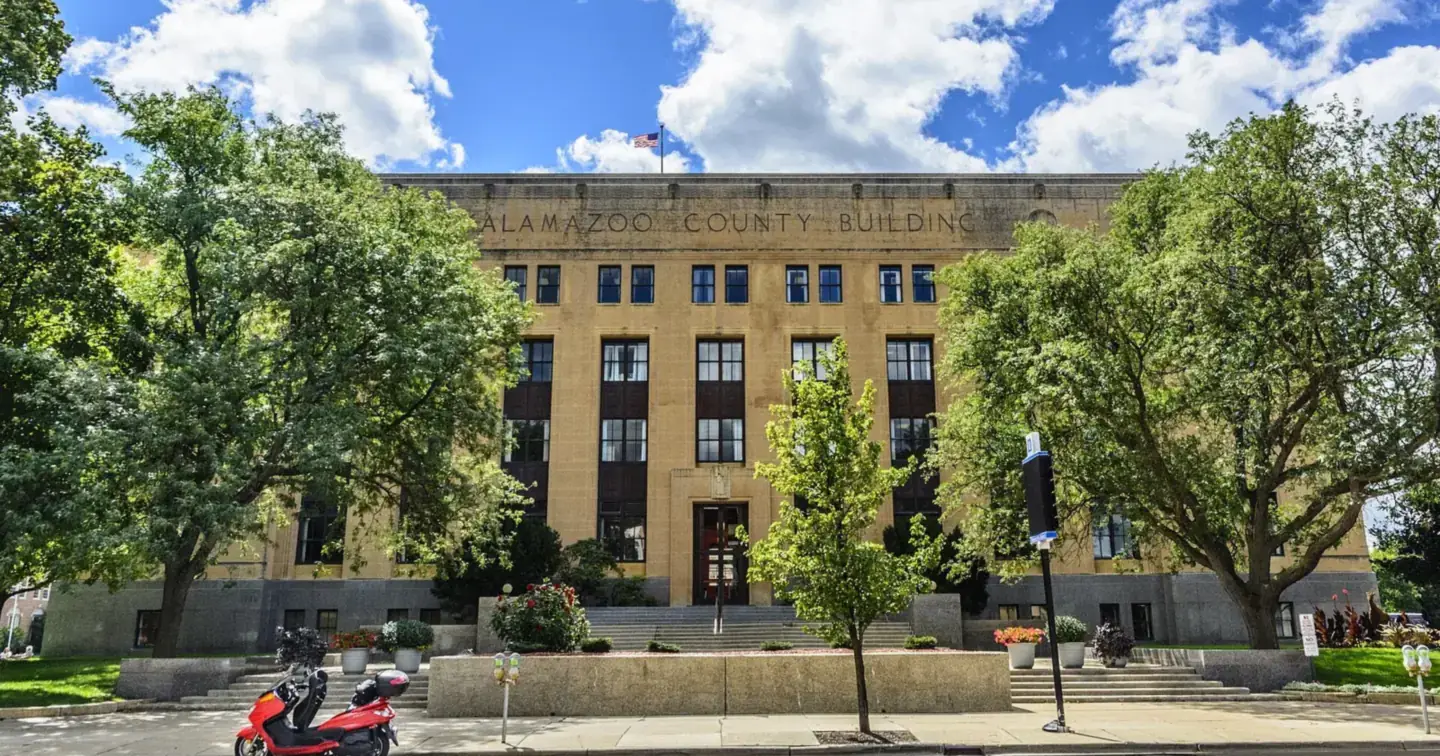
Kalamazoo County gives you 25 months after taxes go delinquent; for 2025 taxes, redemption ends at 5pm on March 31, 2028.
Forfeiture on March 1, 2027, adds a $175 fee and raises interest to 1.5% a month. Until March 31, you can pay the full balance, ask about a Treasurer payment plan if you qualify, or sell.
This is general information, not legal advice. State rules vary.
Jump to a section
How far behind are your property taxes?
Free. No obligation. You choose the closing date.
Kalamazoo County property tax foreclosure runs on a fixed calendar. The County Treasurer's timeline says that once the county takes over an unpaid bill, it has 25 months to be paid in full before foreclosure. For 2025 taxes, that clock started March 1, 2026, and redemption ends at 5pm on March 31, 2028.
This guide walks through that clock for houses in Kalamazoo, Michigan, and the rest of Kalamazoo County. It covers each dated step, what each one adds to the bill, the Treasurer's payment plans, and selling before the deadline. For the statewide rules, see the Michigan property tax foreclosure guide. Nothing here is legal or tax advice.
How long does Kalamazoo County give you to pay delinquent property taxes?
Kalamazoo County gives you about 25 months from the day an unpaid bill turns delinquent to the day redemption rights expire. The county takes over the bill on March 1, forfeits the house a year later, and forecloses on March 31 of the following year.
"Once property taxes are assumed by the County, a tax bill has only 25 months to be fully paid before foreclosure takes place."
Kalamazoo County Treasurer, Tax Foreclosure Timeline
Those dates come from Michigan's General Property Tax Act, so they repeat every year. Your city, township, or village sends the summer and winter bills. Whatever is still unpaid after the last day of February becomes payable to the County Treasurer instead.
Three stages, three dates
- Delinquency (March 1, year one): The county adds a 4% administration fee and interest of 1% a month (MCL 211.78a).
- Forfeiture (March 1, year two): A house delinquent for 12 months or more "is forfeited to the county treasurer," and a $175 fee is added (MCL 211.78g).
- Foreclosure (March 31, year three): The court's judgment takes effect, and redemption rights expire that day in an uncontested case (MCL 211.78k).
Forfeiture sounds final, but it is not. The Treasurer's page says forfeiture "is not the same as foreclosure," although it signals that a house is in danger. You still own the house during that year.
The Kalamazoo County property tax foreclosure timeline for 2025 taxes
For unpaid 2025 taxes, the Treasurer's example runs from March 1, 2026, to a foreclosure on March 31, 2028, with a public sale from August to October 2028. The table lists each dated step and the charge it adds, as the county prints them.
| Date | What happens | What it adds to the bill |
|---|---|---|
| February 28, 2026 | Last day to pay the local city, township, or village treasurer | Nothing yet |
| March 1, 2026 | Taxes become delinquent and payable to the Kalamazoo County Treasurer | 4% administrative fee; interest of 1% a month begins |
| October 1, 2026 | Pre-forfeiture notice | $15 notice fee |
| March 1, 2027 | Forfeiture; Notice of Forfeiture recorded with the Register of Deeds | $175 title search fee; $30 recording fee and $30 redemption fee; interest rises to 1.5% a month; 6% retroactive interest |
| August 1, 2027 | Treasurer's representatives visit forfeited houses in person | $50 site visit fee |
| December 1, 2027 | Forfeited houses with balances published in the Kalamazoo Gazette | $50 publication fee |
| January-February 2028 | Show Cause hearing, then the foreclosure hearing in Circuit Court, where the judge signs the order | Interest accrues monthly |
| March 31, 2028 | Redemption ends at 5pm in the Treasurer's office (postmarks not accepted); without payment or an extension agreement, ownership transfers to the Treasurer | Last day to pay the full balance |
| June 1, 2028 | Transfer if an extension agreement was not kept and the house was not redeemed | Not applicable |
| April 1-July 1, 2028 | Former owners file a Notice of Claim to seek remaining proceeds | Not applicable |
| August-October 2028 | The county's public sale of foreclosed houses | Not applicable |
| January-May 15, 2029 | Certified Proceeds Notice to claimants, then motions in Circuit Court from February 1 to May 15 | Not applicable |
The same calendar runs one year earlier for unpaid 2024 taxes. Under the same statutes, those taxes were forfeited on March 1, 2026, and redemption on them would end on March 31, 2027. The Treasurer's office can confirm which tax years are open on a specific parcel.
What do Kalamazoo County delinquent property taxes add up to?
Kalamazoo County delinquent property taxes grow through a 4% fee, monthly interest that rises from 1% to 1.5% at forfeiture, a 6% retroactive charge, and $350 in flat fees. The county's own fee schedule says these charges "can quickly add up" (Kalamazoo County Treasurer, November 2026).
The extra half percent comes from the forfeiture section of the statute, which adds interest at "1/2% per month" on top of the first-year rate (MCL 211.78g(3)). The flat fees each pay for a step the county has to take, such as recording, a site visit, or a newspaper notice.
4% administrative fee
Added March 1 of the first delinquent year, on the unpaid taxes.
Interest of 1% a month
Starts the same day and runs on the taxes first returned as delinquent.
$15 notice fee
Added October 1 for the pre-forfeiture mailing.
$175 plus $60 at forfeiture
A title search fee, then $30 to record forfeiture and $30 to record redemption.
1.5% a month plus 6% retroactive
From forfeiture on, plus a one-time 6% retroactive interest charge.
$50 visit and $50 publication
Added August 1 and December 1 of the forfeiture year.
An illustration on $1,000 of unpaid taxes
As an illustration only, take $1,000 of unpaid 2025 taxes and apply the county's rates. The 4% fee adds $40. Interest runs $10 a month in the first year and $15 a month after forfeiture, and the 6% retroactive charge adds $60. The flat fees add another $350. Your own balance depends on your bill, and the Treasurer's office gives the exact figure.
The City of Kalamazoo says unpaid water and sewer charges become a lien, and city balances unpaid on November 1 can be added to the next summer tax bill. Our guide to water bill liens when you sell a Kalamazoo house covers that process.
Can you get a payment plan from the Kalamazoo County Treasurer?
Yes, if you qualify as financially distressed, the Kalamazoo County Treasurer can set up a payment plan through a Foreclosure Extension Agreement. Every agreement starts with a 20-minute Foreclosure Extension Appointment with the Treasurer or a designee.
The state law behind it says a county "may create a delinquent property tax installment payment plan" for a house owned by a financially distressed person (MCL 211.78q). The county's Foreclosure Prevention page says the appointment builds the plan and connects people with other support. It also sets the steps to finish by May 31 to avoid foreclosure.
What to bring to the appointment
The county asks applicants to complete a Deferred Foreclosure Intake Packet first. It also lists documents to bring, as they apply:
- Federal and state income tax returns
- Recent statements for bank, retirement, and other financial accounts
- Proof of income, such as Social Security or veterans benefits
- The most recent mortgage statement, including any reverse mortgage
- Recent utility and water bills addressed to an adult living at the house
- Proof of the monthly expenses on your budget
What happens if a plan is not kept
An agreement changes the final date, not the outcome of missed payments. In the county's 2025 example, a house under an agreement that is not kept transfers to the Treasurer on June 1, 2028, if it was not redeemed. For owners who can keep up with the payments, a plan can be a real alternative to selling.
Can you sell a house with back taxes in Kalamazoo before March 31?
Yes, you can sell a house with back taxes in Kalamazoo at any point before redemption rights expire. At closing, the delinquent taxes, interest, and fees are typically paid from the sale proceeds, and the rest goes to you.
Forfeiture does not transfer ownership, so you can still sell. The county records a Notice of Forfeiture with the Register of Deeds, which puts the debt on the public record a buyer's title search reads. The Treasurer's office can give an exact payoff figure for a closing date.
Timing around the deadline
- Lead time: A closing needs a title search, a payoff, and signatures, and each step takes days.
- The 5pm rule: The county requires payment by 5pm on March 31 in its office and does not accept postmarks.
- Other liens: A water lien can also affect a sale until it is paid, the City of Kalamazoo says.
Heirs face the same calendar on an estate house, and probate can take time. Our guide to selling an inherited house in Kalamazoo explains that side. If a mortgage is also behind, the guide to foreclosure timelines in Kalamazoo County covers the lender's process.
What happens to your equity if the county forecloses?
If the county forecloses, ownership and the equity in the house pass to the County Treasurer on March 31 in an uncontested case. A former owner can seek any remaining proceeds only through the claim process in MCL 211.78t.
Equity can be large next to a tax debt. Redfin reports a median sale price of $223,594 in Kalamazoo for the three months ending September 2026 (Redfin, September 2026).
How a remaining proceeds claim works
A claimant "must notify the foreclosing governmental unit using a form prescribed by the department of treasury" by the July 1 after foreclosure (MCL 211.78t). In the county's 2025 example, the steps are:
- The Notice of Claim is due between April 1 and July 1, 2028.
- A Certified Proceeds Notice goes to claimants in January 2029, showing any amount available.
- Claimants file a motion in Circuit Court between February 1 and May 15, 2029.
- The court holds hearings between June 1 and December 31, 2029; payment follows within 21 days of the order.
Remaining proceeds are what is left after the county takes the delinquent taxes, interest, fees, and its costs. The statute also deducts a sale commission "equal to 5% of the amount paid" for the house. The wait from foreclosure to payment can run well over a year.
The Kalamazoo County Land Bank, founded in 2010, also works with the county. It takes tax-foreclosed, blighted, and underutilized parcels and works to return them to active use.
How can Propcash help with a house behind on taxes?
Propcash is a direct cash homebuyer, and we can buy houses in Kalamazoo as-is, with the back taxes paid from the proceeds at closing. We'll make you one cash offer based on local market data and show you how we got to our number. Cash sales can close in as few as 7 days, and you pick the closing date.
A cash offer is one option to compare with a Treasurer payment plan, a listing with an agent, or paying the balance. If a cash sale is not your best move, Propcash will tell you. You can get a no-obligation cash offer or see how we buy in the area on our Kalamazoo cash home buyer page.
Frequently Asked Questions
Who collects Kalamazoo property taxes after the last day of February?
Once February ends, unpaid taxes become delinquent and are payable to the Kalamazoo County Treasurer, not to your city, township, or village treasurer. The county's main address is 201 W. Kalamazoo Ave. in Kalamazoo. Its timeline lists the phone number 269-384-8124 and the email treasurer@kalcounty.com for questions.
Does forfeiture mean the county already owns your house?
No. The Kalamazoo County Treasurer's own timeline says forfeiture is not the same as foreclosure, though it does signal that a house is in danger of foreclosure. You still own the house after forfeiture and can pay the balance or sell. Ownership moves to the Treasurer only if the balance is still unpaid when redemption rights expire on March 31 of the foreclosure year.
Will a payment mailed on March 31 stop a Kalamazoo County tax foreclosure?
No. The county's timeline says the taxes must be paid by 5pm in the Kalamazoo County Treasurer's Office on March 31 and that post marks are not accepted. A check that is still in the mail on that day does not count. Owners who plan to pay near the deadline often call the office first to confirm the exact amount and the accepted ways to pay.
What happens if you sign an extension agreement and then miss a payment?
In the county's example for 2025 taxes, a house under an extension agreement that is not kept and not redeemed transfers to the Kalamazoo County Treasurer on June 1, 2028. That is about two months later than the March 31 date that applies without an agreement. The Treasurer's office can explain the exact terms of a specific agreement.
Can unpaid Kalamazoo water bills turn into property taxes?
Yes. The City of Kalamazoo says unpaid water and sewer charges become a lien on the house under Michigan law. City balances still delinquent on November 1 can be added to the next summer property tax bill. Once on the tax roll, an unpaid balance is collected like other property taxes. A separate Propcash guide covers water and sewer liens in Kalamazoo.
Does a former owner have to act to get money from the county's public sale?
Yes. Under MCL 211.78t, a former owner who wants remaining proceeds must notify the county on a Michigan Treasury form by the July 1 after foreclosure. In the county's 2025 example, that window runs from April 1 to July 1, 2028. Claimants then file a motion in Circuit Court between February 1 and May 15, 2029. Without the notice, the claim process does not start.
Reviewed by the Propcash Editorial Team under our editorial standards. Published by Propcash, a direct cash buyer of houses. This guide is general information. Laws, fees, and market figures change, so check the current rules for your state.