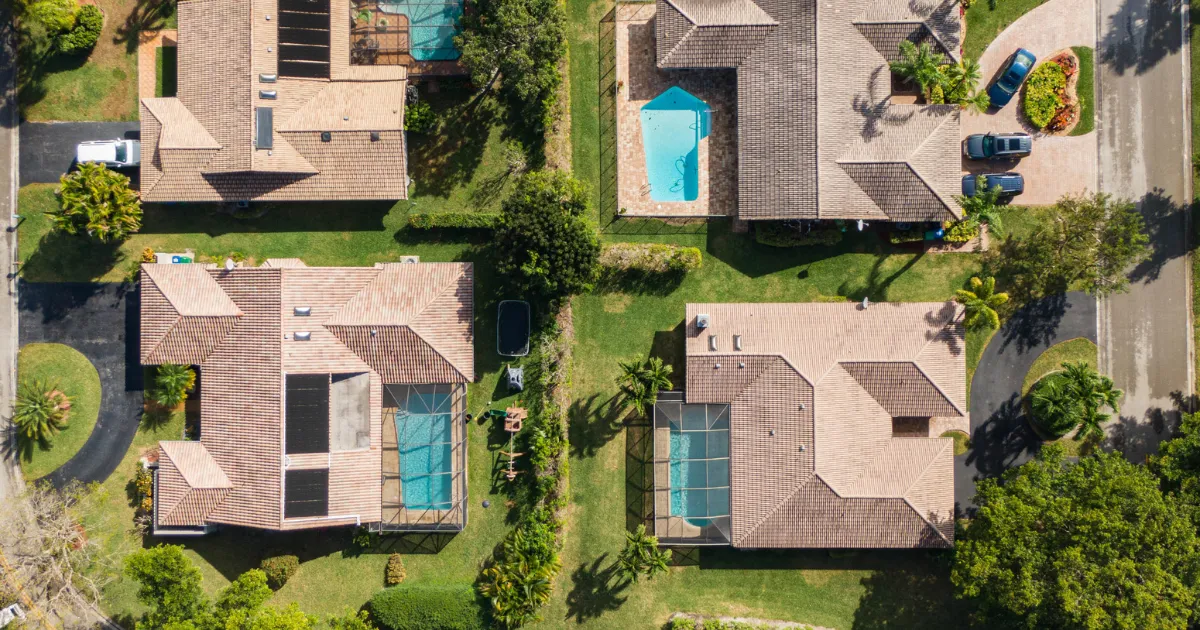
Yes, you can sell a Port St. Lucie house on a septic tank as it is, or convert to City sewer first.
The City now lists the conversion at $9,445 in a Special Assessment District, or $77.79 a month for 120 months interest free, plus a $110 deposit and a $45.50 recording fee. A financed conversion records a CCA lien that is paid off at closing or assumed by the buyer.
This is general information, not legal advice. State rules vary.
Jump to a section
Is your Port St. Lucie house still on a septic tank?
Free. No obligation. You choose the closing date.
If you want to sell a house with a septic tank in Port St. Lucie, the first number to know is the City's new conversion price. The City of Port St. Lucie now lists conversion cost at $9,445 for houses in a Special Assessment District, effective October 1, 2026. It can also be paid at $77.79 a month for 120 months, interest free, plus a $110 sewer deposit and a $45.50 recording fee.
That price shapes one decision: pay to convert before you sell, sell with the tank as it is, or convert on the City's payment plan and let the balance travel with the sale. This guide lays out the rules behind each path for owners, retirees, and heirs of older platted-lot houses.
Can you sell a Port St. Lucie house with a septic tank?
Yes. Florida does not require a septic inspection or a sewer connection before a house can change hands, and a working tank can be sold as it is.
The state statute on septic systems says so directly. It also says a septic permit transfers with the title, and that a title may not be burdened at transfer by newer permit rules than the ones in effect when the system was permitted.
"An inspection of a system may not be mandated by a governmental entity at the point of sale in a real estate transaction."
Fla. Stat. § 381.0065(4)(x), Florida Statutes
A buyer can still ask for an inspection, and many contracts include one. That is a term the buyer and seller agree to, not a state rule.
City limits or County rules
The conversion program, the CCA lien, and the connection rule below are City of Port St. Lucie rules. They apply inside the city limits. A house outside the city limits, in unincorporated St. Lucie County, is not covered by these City rules, so check the jurisdiction of your address first.
Septic is common here because of how the city was built. The City's Planning and Zoning page says the original developer platted 66 square miles into mostly single-family lots, with minimal infrastructure. The City's 2025 fact sheet counts 12,501 septic tanks remaining as of August 31, 2025.
What does the City charge to convert septic to sewer in 2026?
Inside a Special Assessment District, the City charges $9,445 to convert a septic system to City sewer, effective October 1, 2026. The City says costs outside these districts may vary.
The City's rate sheet for October 2026 gives both figures for a wastewater-only, low-pressure connection:
- Inside a Special Assessment District (USA/SAD areas): $9,445 paid in full.
- Outside those areas: $11,417 paid in full, or $95.14 a month on the 10-year plan.
- Due with the application either way: the $110 deposit and the $45.50 recording fee, $155.50 in all.
The program page lists $77.79 a month for 120 months inside a district. The City's October 2026 rate sheet lists $78.71 a month for the same service. Connection Support at 772-873-6400 can confirm the figure for a given house.
What the price covers
The City says it provides all materials and labor to connect the house's plumbing to the low-pressure sewer system. The fee also reserves treatment plant capacity for the house. The finished system is a 200-gallon collection tank and a sewer pump buried in the yard, with a control panel on the side of the house.
The City says the process takes 4 to 6 weeks from application to completed installation. More than 11,000 residents have converted since 1999, and the City averages 350 conversions a year.
- Step 1Appointment with Connection Support and the paperwork
- Step 2A pre-inspection of the site
- Step 3An electrician installs the grinder control box
- Step 4A sewer crew runs the service line
- Step 5The old tank is abandoned and the new system installed
- Step 6The City restores the yard with new sod
Paying over time
The City offers a 10-year, interest-free plan with no financial qualifications. Every owner's signature must be notarized to use it. The City is no longer accepting grant applications for this program.
When does a Port St. Lucie house have to connect to sewer?
Inside the city limits, a house on septic must connect to City sewer when the tank fails or someone seeks a permit to replace the tank or drainfield, if sewer is available.
That rule is in City Code Sec. 63.25. It says such a house "will be required to be connected to the City's wastewater system when the septic tank fails or a permit is requested from the St. Lucie County Health Department or other appropriate authority for a septic tank or drainfield replacement."
The state connection rules
Florida law adds two timelines (Fla. Stat. § 381.00655):
- A system that needs repair to work in a sanitary manner must connect to available sewer within 90 days after written notice from the state department.
- A working system must connect within 365 days after the sewer utility gives written notice that sewer is available.
For a single-family house, "available" generally means a gravity or low-pressure sewer line sits in a public right-of-way or easement that abuts the lot, with capacity to serve it (Fla. Stat. § 381.0065(2)(a)). If you have received a written availability notice, Utility Systems can tell you where your house stands.
The practical result for a seller: a working tank can be sold, but the next owner may face a connection the day the tank fails. Buyers may price that in.
How does the Port St. Lucie septic to sewer lien work when you sell?
When an owner finances the conversion, the payment plan becomes a recorded lien on the house, and at a sale it is either paid off or assumed by the buyer.
The City's Lien Services page lists capital charge liens for connections to City water or wastewater. The cost "can be amortized through a 10-year interest-free loan, which becomes the utility capital charge lien." The paperwork is called a capital charge agreement, or CCA.
Paying it off at closing
Lien Services is the City's one stop for lien payoff amounts and written lien documents for a sale. It gives CCA information by phone at 772-344-4179, free of charge. For a sale, Lien Services provides the payoff amount and a written lien document, and the balance can be paid from the seller's proceeds at closing.
Letting the buyer assume it
A buyer can apply to continue the CCA through the City's Subordination and Assumption Application. The City's page sets out the terms:
- Fees are $200 for an assumption on a cash deal, or $200 for an assumption with subordination. All fees are non-refundable.
- A lien search through Lien Services is required for every assumption, for an $80 fee.
- The City asks for at least 10 business days for routine cases. Trusts, LLCs, and changed title commitments can take longer.
- City utility accounts must be current before the agreements are processed.
- The City will not subordinate past second position, which matters when the buyer has a mortgage.
The application asks for the title commitment, all recorded pages of the CCA, and the deed by which the seller took title. The City notes that the recorded documents can be found in the St. Lucie County Clerk's official records.
Other City liens can sit on the same house. Our guide to selling a Port St. Lucie house with a code or building lien covers those, and swale or culvert cases are covered in our Port St. Lucie drainage guide.
Convert first, sell as-is, or sell with the CCA: how do the paths compare?
Converting first costs the most up front, selling as-is costs nothing up front but passes the tank to the buyer, and selling with a CCA splits the cost over time.
| Path | Cost to the seller | Time | Who pays | What the buyer sees |
|---|---|---|---|---|
| Convert first, paid in full | $9,445 in a district or $11,417 outside, plus $155.50 at application (City, October 2026) | 4 to 6 weeks from application to installation, before the sale | The seller | A house on City sewer with no conversion balance |
| Sell with the tank as it is | No conversion cost; a buyer may price the tank into the offer | No conversion wait | The buyer, when the tank fails or a drainfield permit is sought | A septic tank, and the City's connect-on-failure rule |
| Convert on the plan, then pay off at closing | $155.50 at application, then the remaining balance from proceeds | 4 to 6 weeks to convert, plus a payoff from Lien Services | The seller, out of the sale | A house on City sewer with the lien released |
| Sell with the CCA assumed | Payments made before the sale; a $200 assumption fee and an $80 lien search apply | At least 10 business days for routine assumption agreements | The buyer takes over the remaining monthly payments | A house on City sewer with a recorded CCA lien |
When converting first may fit
Converting first can make sense when the tank is already showing trouble and you plan to list with an agent. A buyer with a mortgage sees a finished sewer connection. The cost is the conversion price and a few more weeks before the house goes on the market.
When selling as-is may fit
Selling as-is avoids paying for work the next owner would value at their own price. It suits sellers who want a set closing date and no project in the yard. As-is means as-is: the tank, the drainfield, and the decision about sewer go to the buyer.
What might a buyer, lender, or inspector ask about a septic tank?
Buyers often ask whether the house is on septic or sewer, whether City sewer is available at the street, and whether a CCA lien is recorded.
A buyer may also ask when the tank was last pumped. The City says a septic tank generally needs pumping every three to five years. Its program page lists warning signs of a failing system:
- Gurgling noises when water runs or a toilet flushes.
- A rotten-egg odor.
- Toilets or drains that will not clear.
- Backups during or after heavy rain.
- Standing water in the yard.
A financed buyer's lender may have its own septic or sewer conditions, and those differ from loan to loan. A cash buyer does not need bank underwriting, so those conditions do not arise in a cash sale.
Sewer has running costs too. The City says the average combined water and sewer bill for a two-person household is $97.60, based on 5,000 gallons. It also says the City maintains the sewer system and covers those costs.
What should heirs and out-of-town owners know about a house on septic?
Heirs often inherit an older platted-lot house still on septic, and the conversion choice usually waits until someone has authority to sell.
Two City rules matter here. The 10-year plan requires every owner's signature to be notarized. Assumption cases involving trusts or a transfer of the lien can take longer than the routine 10 business days. If the estate is still open, our guide to selling an inherited house in Port St. Lucie covers probate in the Nineteenth Judicial Circuit.
A Florida attorney can explain who may sign for the estate, and a tax professional can explain how a sale affects the heirs.
How can Propcash help with a Port St. Lucie house on septic?
Propcash is a direct cash homebuyer that can buy a Port St. Lucie house as-is, still on a septic tank or carrying a CCA lien. There is no conversion to fund, no repairs, and no showings, and recorded City liens are typically settled from the proceeds at closing.
Sellers pay no fees or commissions, and you pick the closing date, which can be as few as 7 days after the contract is signed. Our offer is based on local market data, and we show you how we got to our number, so you can set it beside the cost of converting first or listing. If a cash sale is not your best move, we will tell you. You can get a no-obligation cash offer or compare options on our Port St. Lucie cash sale page and our guide for houses that need major repairs.
Frequently Asked Questions
Does Florida require a septic inspection before a house can be sold?
No. Florida law says a governmental entity may not mandate an inspection of a septic system at the point of sale in a real estate transaction (Fla. Stat. 381.0065(4)(x)). A buyer or a buyer's lender can still ask for one as part of the deal. That is a contract term between the parties, not a state requirement.
Can a buyer take over my septic to sewer payment plan?
Often, yes. The City of Port St. Lucie has a Subordination and Assumption Application for buyers who want to continue a seller's capital charge agreement. The City lists a $200 fee for an assumption, requires a lien search through Lien Services for $80, and asks for at least 10 business days for routine cases. City utility accounts must be current before the agreements are processed.
How do I find the balance on my Port St. Lucie sewer connection lien?
To verify the balance, the City says to email utility@cityofpsl.com or call Connection Support at 772-873-6400. Lien Services also gives CCA information by phone at 772-344-4179, free of charge. For a sale, Lien Services handles payoff amounts and written lien documents.
Do the City's septic rules apply to a house outside the Port St. Lucie city limits?
No. The City's conversion program, its code rules, and its Lien Services cover houses inside the City of Port St. Lucie. A house outside the city limits, in unincorporated St. Lucie County, is not covered by these City programs. The state septic statutes apply in both places.
Are septic to sewer grants still available in Port St. Lucie?
Not through the City's program page right now. The City says it is no longer accepting grant applications for the Septic to Sewer Conversion Program. The 10-year, interest-free payment plan is still offered, and the City says it requires no financial qualifications.
Who maintains the sewer pump after a Port St. Lucie house is connected?
The City does. Its program page says that with City sewer, the maintenance is managed and all costs are covered by the City. The owner pays a monthly wastewater fee, and an alarm on the control panel signals a problem that the City's Connection Support line handles around the clock.
Propcash is a direct cash homebuyer, not a law firm, and this guide is general information. City fees and rules change, so confirm current figures with the City of Port St. Lucie Utility Systems Department and Lien Services. A Florida real estate attorney can explain how these rules apply to your house.
Reviewed by the Propcash Editorial Team under our editorial standards. Published by Propcash, a direct cash buyer of houses. This guide is general information. Laws, fees, and market figures change, so check the current rules for your state.